
Journeys
Journeys is a visual, node-based flow builder. It lets you design a hyper-personalized, time-based path through LiveOps content. Think of a journey as a map of the different paths a player moves along, where:
- Each node is a journey step with options to trigger in-game actions, wait for a duration, or branch into more paths.
- Each player runs the flow on their own clock instead of a shared global schedule.
- Branching is driven by player properties and behaviours.
- Custom logic is extensible with Webhooks.
- Flows can repeat as recurring loops.
You can build a journey to:
- Onboard new players: guide them through their first sessions to their first real win.
- Win back lapsed players: reach players who have stopped playing and bring them back in.
- Unblock stuck players: spot players failing the same level and move them past it.
- Grow spend: offer a bigger deal each time a player buys.
Why journeys #
Satori already gives you the building blocks for LiveOps with audiences, remote configs and experiments. These tools define who the player is and what they should see. Journeys answer a different question: what happens next.
Instead of defining properties of a target group, as you would do with an audience, you design a sequence. This can be a trigger, a wait, a branch, a user action, all responding to what a player does.
Take a new player. The happy path is that they’re still playing a week in, and you reward them for it. What if they drift off before then? In that case, you might want to re-engage them:
| |
With journeys, you can:
- Map out the whole flow in one place. No need to wire up separate campaigns.
- Run the campaign on each player’s own clock rather than a shared calendar.
Put another way, a journey is a campaign that spans over a player’s lifecycle.
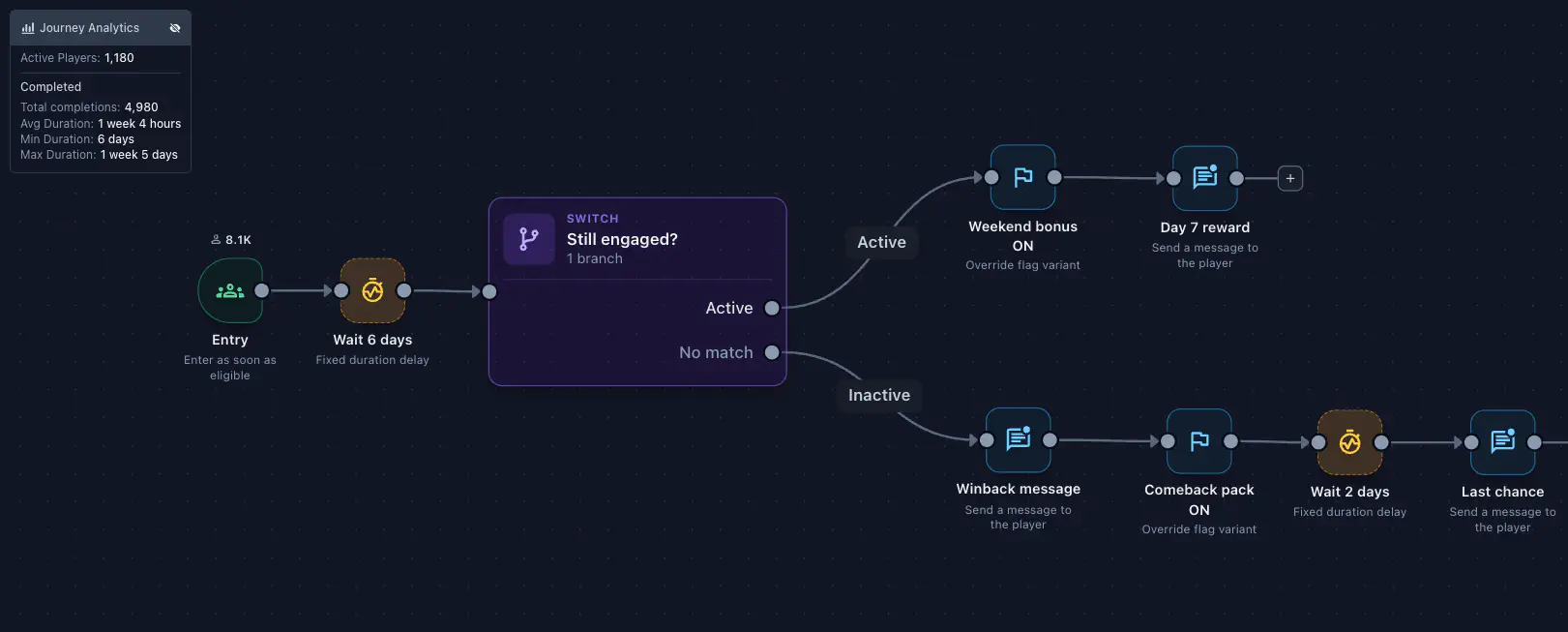
How it works #
Journeys is a modular system built from four kinds of components, which between them control who enters, what each player receives, and when.
Entry
Sets which players start the journey, and when.
Actions
Give the player something on arrival: a message, a live event, an experiment, or a flag variant.
Delays
Hold the player until a duration elapses or a scheduled time arrives.
Conditional branches
Ask a question about the player, then send them down the path that matches.
Entry #
Each journey carries one or more entry triggers, and a player who matches any one of them is admitted.
| Trigger | Admits a player when |
|---|---|
| Immediate | They match the trigger’s property condition. Without a condition, every player enters. |
| Live Event | They’re participating in a named live event. Choose whether participation that began before the journey started counts. |
| Experiment | They’re enrolled in a named experiment phase, optionally a specific variant. Choose whether enrollment that began before the journey started counts. |
Two more settings shape who gets in. Start and end times bound the period when a journey admits anyone at all. Enable a journey before its start time and it reports as Scheduled, turns Running once the window opens, and Terminated after the end time passes.
The rejoin cooldown decides what happens once a player reaches the exit. By default they never come back. Set a cooldown and they become eligible again after it elapses, which turns a one-off flow into a recurring one such as a weekly check-in.
Actions #
An action gives the player something the moment they arrive, then hands them to the next step. Switch on a weekend bonus, send a day 7 reward: both are actions.
Actions reach your game through the Satori systems your game already reads, so you can add a journey without shipping a client update.
| Action | What it does |
|---|---|
| Send Message | Sends a message to the player from a template, through the in-game inbox, an external integration, or both. |
| Add to Live Event | Enrolls the player in a live event. |
| Add to Experiment | Enrolls the player in an experiment phase. |
| Set Feature Flag | Overrides a feature flag with a specific variant for that player. |
| Enter Journey | Enrolls the player in another journey, so small flows compose into larger ones. |
| Webhook | Sends a JSON payload to your own services, so a step can reach systems outside Satori. |
| Revert Step | Undoes an earlier step in the same journey, removing the live event, experiment phase, or flag variant the player received there. |
Add to Live Event is worth a closer look. The step admits the player to the event, and the event’s participation duration then decides how long they stay in it, counted from their own join. For example, a 48-hour offer runs for 48 hours from the point the player reaches that step.
The duration is configured on the live event itself. See more details at participation duration.
Delays #
A delay holds the player in place before the next step runs. This is what puts a journey on the player’s own clock rather than a shared calendar.
A Wait step pauses for a fixed duration, counted from the moment that player arrived. A six-day wait lands on each player’s own day six, not on one date for everybody.
A Time Window step waits for a specific date instead, or for the next slot in a recurring schedule such as 9 AM every Saturday. Recurring schedules resolve in UTC or in the player’s own timezone, so a step meant for Saturday morning lands on Saturday morning wherever they are.
Conditional branches #
A branch asks a question about the player, then sends them down the path that matches. Did they come back? Did they buy? Which spend tier are they in? You branch on the same player properties your audiences filter on, so anything you can segment on, you can branch on.
This is what lets one journey cover outcomes that would otherwise be separate campaigns. Each player only ever meets the arm that fits them.
A branch can also wait for its answer instead of taking one straight away. Use that when the thing you’re watching for could happen any time over the next few days: a purchase, a completed level, a return to the game. Players who never do it leave by the timeout path once the wait elapses.
Key capabilities #
| Act through the configuration your game already reads | Journey actions work through feature flags, live events, and experiment phases. Your game keeps making the same Satori calls and receives different values as the player advances, so adding or changing a journey needs no client release. |
| Set the pace to each player's own clock | Hold a player for a fixed duration, until a specific date, or until the next occurrence of a recurring schedule, resolved in their own timezone. |
| Undo what an earlier step granted | A Revert Step action removes the live event, experiment phase, or flag variant a player picked up earlier in the same journey. |
| See where players stop | Per-step player counts sit on the canvas itself, alongside totals for active and completed players and the fastest, slowest, and average time to finish. |
| Explain what one player received, and why | An identity's page lists the journeys that player is in and every step they've passed through, with timestamps, so you can answer a support question without reconstructing the run from logs. |
| Reuse a flow inside another | An Enter Journey action enrolls the player into a second journey, so a shared sequence such as a welcome flow is written once. Journeys can't enroll into each other in a cycle. |
