
Introduction to Satori
A live game generates signals continuously. Running LiveOps at scale comes down to solving four problems: targeting the right players with the right content at the right moment; escaping the operational drag of a fragile stack of stitched-together tools; moving at the speed of player behaviour shifts with live updates; and knowing with confidence which changes are actually moving your metrics.
These four capabilities are what Satori is built to deliver: precise lifecycle intervention, a unified operational platform, real-time configuration, and evidence-based iteration.
Satori is the LiveOps platform from Heroic Labs, giving game studios a single place to understand their players, deliver live content at scale, and personalise every experience. The mental model behind Satori is simple: events → player properties → audiences → personalized experience.
Satori has three main interfaces:
- A browser-based console your LiveOps team uses. All operations (configuring events, adjusting targeting, reading results) are fully managed via the console with no engineering involvement.
- A client SDK your engineering team integrates.
- A console API that lets your backend or tooling manage the platform programmatically.
Key capabilities #
Player journeys
- Tailor experiences to each individual player with hyper-personalization
- Build repeatable flows with actions, delays, and branches
- Trigger messages, live events, experiments, flags, and webhooks
Segmentation
- Build audiences from behavior, spend, device, location, or custom attributes
- Unlimited segments
- Membership updates in near real-time as players send events
Remote configuration
- Update any game parameter without a client update
- Serve different configurations to different segments
- Unlimited feature flags and variants
Live events and experiments
- Customize enrollment with sticky membership and limited window
- Deliver feature variants to scoped segments
- Run A/B test experiments and roll out new features gradually
Player messaging
- Deliver through the in-game inbox, push notifications, or email
- Personalize with player properties and multi-language translations
- Tie delivery to live event timing or a step in a player journey
Performance monitoring
- Track D1-D30 retention out of the box
- Identify drop-offs with funnel analysis
- Measure RoAS per cohort by channel, campaign, country, and variant
- Configurable dashboards for key and custom metrics (ARPDAU, revenue etc)
Satori at a glance #
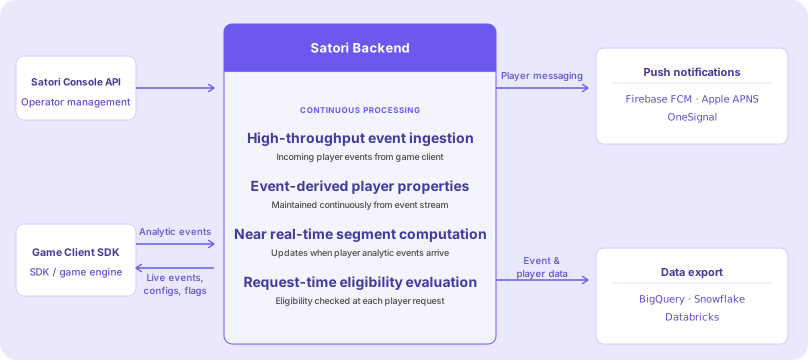
Satori ingests analytic events from your game client at high throughput. Each event updates event-derived player properties, which in turn drive segment membership. Segments stay current continuously: as players send events, their membership is recomputed so targeting always reflects the latest player state.
When a player requests their active live events, experiments, or feature flags, Satori evaluates eligibility at that moment against their current computed state, delivering the most up-to-date assignment every time.
The full LiveOps lifecycle, in one place #
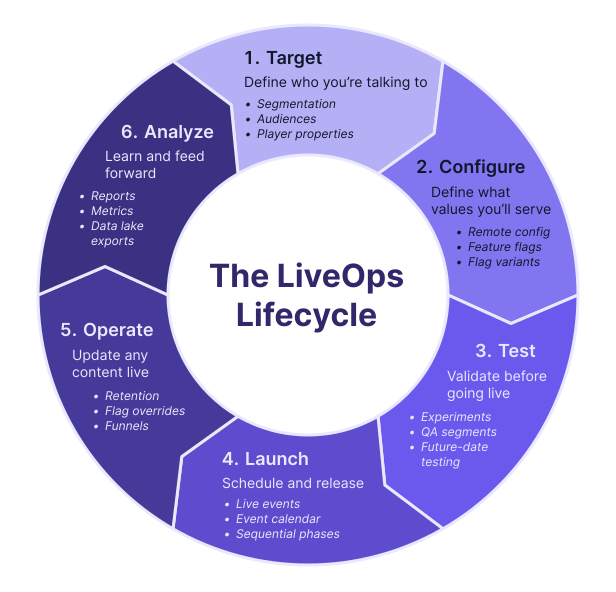
Satori covers the full operational lifecycle in a single platform. Player events captured by the SDK feed the audience computation that determines who enrolls in a live event, which feature flag values they receive, and which experiment variant they are assigned. The live event calendar gives your team a bird’s-eye view of everything scheduled and active. While an event runs, remote configuration lets you mutate reward values, flag overrides, or targeting in real time with no code deploy. When it ends, performance data flows back into the same system, ready to inform the next campaign.
Hyper-personalized player journeys #
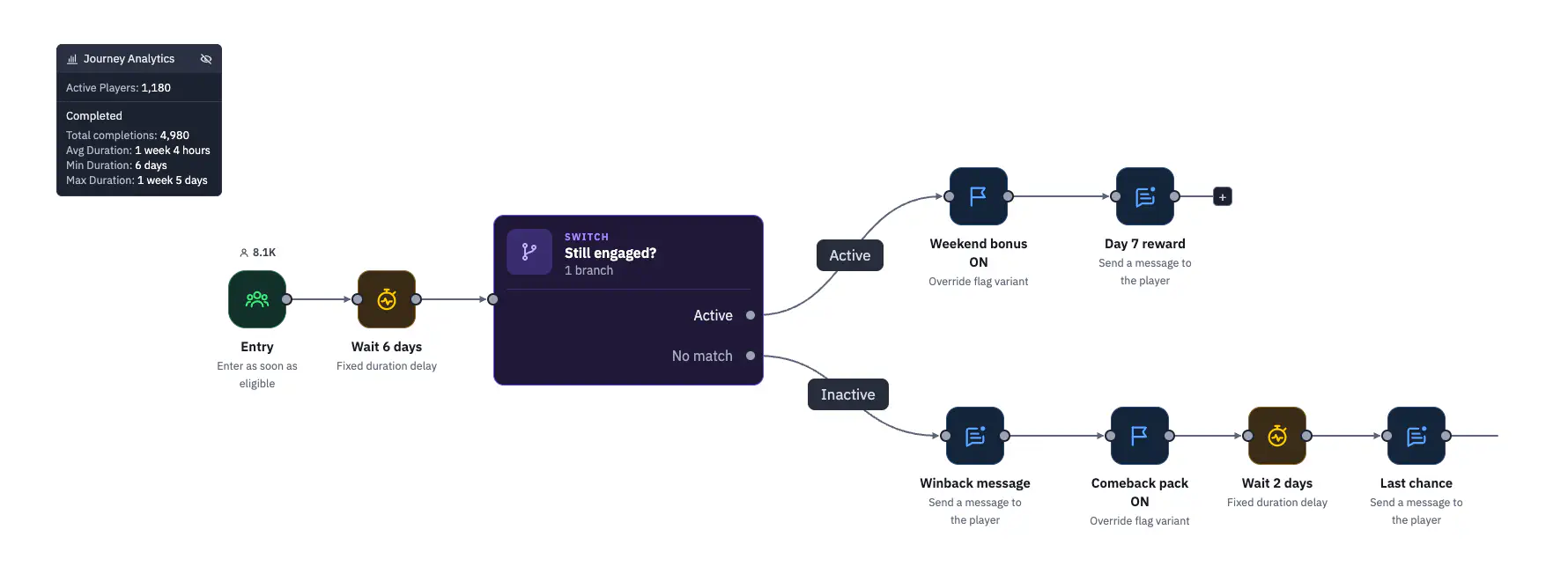
Journeys is a visual tool that lets you lay out a sequence of steps on a canvas and move each player through it at their own pace.
Journeys orchestrate the other pillars of Satori and tailor them for each individual player. Use journeys to build hyper-personalized flows such as onboarding, retention experiences, escalating offers and win-back campaigns.
- Guide a player to their next milestone. Drag and drop nodes to describe a player experience. If the player becomes inactive, add a Message node to send a hint with a push notification. If the player stalls at a level, add a Feature Flag node to lower the difficulty.
- Adapt an experience to a player’s own timing. Use a Delay node to wait for a player for a fixed duration counted from their own arrival, or until the next slot in a recurring schedule, in the player’s own timezone. Use Live Events to run a special offer that starts the moment a player arrives at the step and runs for two days from there.
- Branch a journey on the same player data that powers your segments. Send players down different paths when they make a purchase, reach a spend tier, or clear a challenge.
How Satori is different #
Bring your own data model #
Feature flags power remote configuration in Satori. You define the schema for each flag: the fields and types that represent a meaningful unit of your game world. A flag can carry a complete reward configuration, a set of difficulty parameters, or a shop layout. Experiments and live events then serve variants of that schema to targeted player segments.
Event capture at high throughput #
Send analytic events and their associated properties for ingestion and analysis in Satori via the provided client SDKs. You can propagate events from Nakama automatically to have a full view of user activity, and receive events from any third-party systems you have in place.
One connected player data layer #
Satori maintains a robust identity for every player, combining default properties with custom properties and computed properties generated from your game events. These properties are the foundation of your segmentation, defining the audiences you target with content, offers, and experiments.
All of this is visible in the identity’s behavior stream, where you can view all captured events, edit properties, and see which audiences the player belongs to, which experiments they’re enrolled in, and which feature flags and remote configs apply to them.
Segment data that stays up to date #
Satori recomputes all audiences every 10 minutes by default. When a player sends a game event, their segment membership updates immediately. Live events and feature flags check a player’s eligibility at the moment they make a request.
Measure the impact of your operations #
Define a metric once and apply it to any experiment, feature flag, or live event. Scope a retention report to players in a specific experiment variant, or filter your return on ad spend report to a single live event. Build multi-step funnels from any sequence of analytic events, updated live.
Works with your existing stack #
Satori connects to:
- Data lakes: Export raw events to BigQuery, Snowflake, Amazon Redshift, Amazon S3, or Databricks.
- Mobile measurement partner (MMP) attribution: Connect Adjust to bring cost-per-install data into the return on ad spend (RoAS) report.
- Player messaging: Message integrations deliver messages outside the game through Firebase Cloud Messaging (FCM), Apple Push Notification Service (APNS), and Facebook App-to-User for push notifications, OneSignal for push notifications and email, and webhooks for any other system.
- Webhooks: Webhooks send HTTP requests to your backend when something changes in Satori.
- Managed audiences: Import segments from your existing analytics platform and use them as targeting sources in Satori.
- Hiro: Integrate with Hiro to make Hiro systems, such as economy, achievements, and progression, remotely configurable from the Satori console.
Next steps #
- Integrate Satori into your game by following the get started guide.
- Explore each capability in more depth: segmentation, remote configuration, live events, experiments, journeys, player messaging, and performance monitoring.
- Check the client libraries to start developing your game client.
- Browse the Console API reference for endpoints to manage your instance programmatically.
Need help? Get in touch with the Heroic Labs team.
