
Why Live Service Games Fail: Stack, Cadence, and Ops

Most live service games fail after launch, not at it. The cause is operational: a dead content calendar, no remote config, and an economy that inflates. Here is the LiveOps game stack and cadence that keeps players.
Concord launched in August 2024 and went offline 14 days later. Sony refunded every sale. The headlines said live service was dying. It isn’t. The global games market cleared 200 billion dollars in 2025. What died was one game with no audience and no runway to fix it.
That is the wrong lesson to take. Most live service games that shut down don’t die at launch. They die over months, from a LiveOps game loop that stopped moving. If you run live games at a publisher or a large studio, the question isn’t whether live service works. It’s how to improve game retention after week one, and which retention strategies actually hold. This guide covers why live service games fail, what a live game needs after launch, and how to run LiveOps for a game without guessing.
Why do live service games fail?
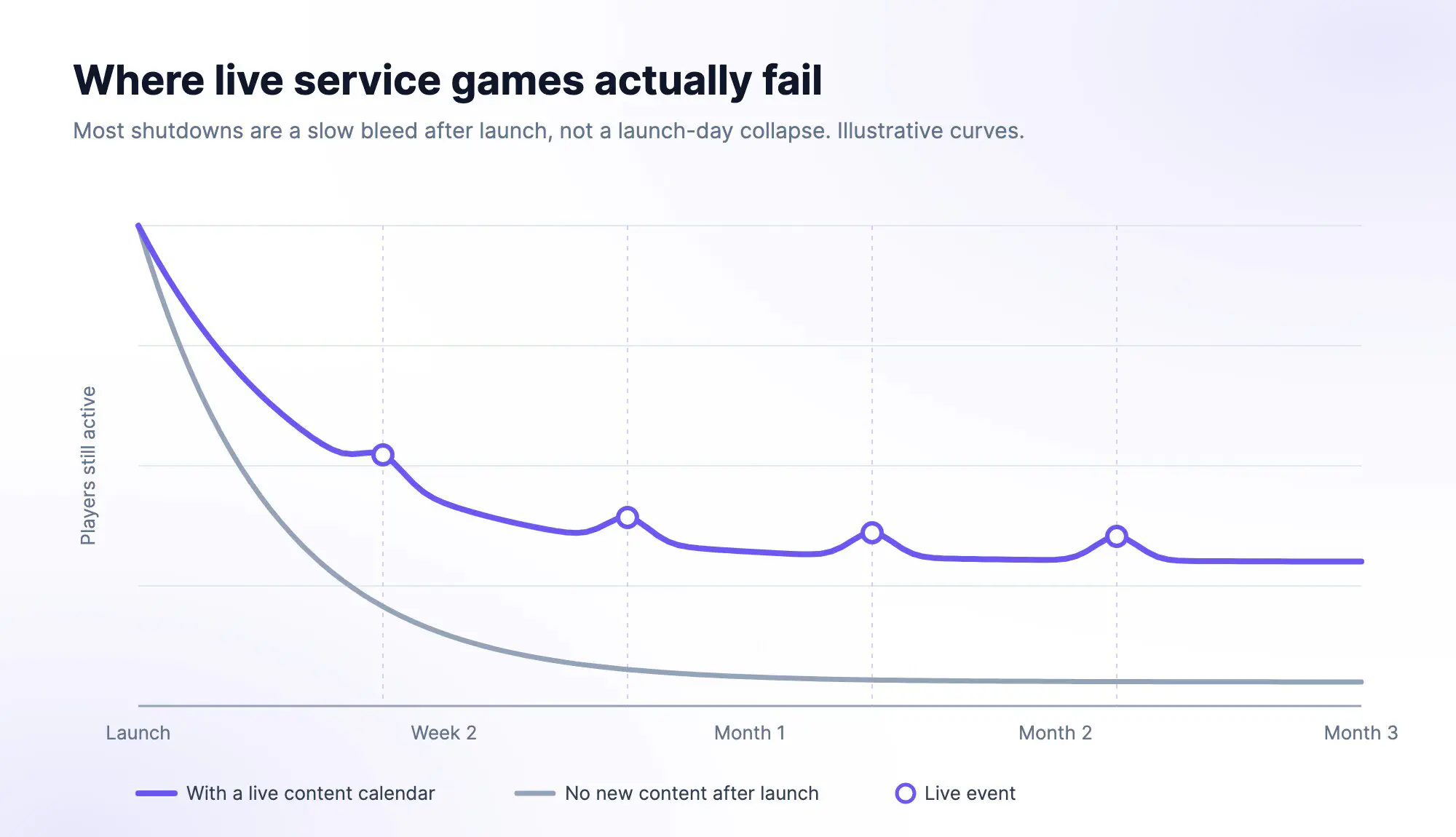
Live service games fail when the operational layer behind them stops evolving. A content calendar goes quiet, values sit hard-coded so nothing changes without a new build, and the in-game economy inflates until rewards mean nothing. Players leave faster than acquisition can replace them, and the unit economics collapse.
Concord is the loud version: no audience, pulled in two weeks. The quiet version is more common and more useful to study. A game finds players, then bleeds them. Marketing agency AppAgent puts it plainly. When a marketed title’s day 30 retention falls below about 3 percent, the cause is rarely creative or targeting. It points to a deeper problem in the product, its progression, or its live ops. That is the tell. Low late-stage retention is an operations problem, not an acquisition problem.
Keeping players past the first week comes down to giving them a reason to return that you control after launch. The player retention strategies that hold are operational. A reason to log in today, a change you can ship this afternoon, and an economy that still rewards effort in month six.
Read the symptom, then check the metric before you guess at the cause.
| Symptom | Likely cause | First metric to check |
|---|---|---|
| Players drop sharply after day one | Weak first-session activation, no early goal | First-day retention by cohort |
| Steady week-over-week bleed | Dead content calendar, nothing new to do | Weekly active users and event participation |
| Spend falls while players stay | Economy inflation, sinks too weak | Currency in circulation versus sink rate |
| Whole regions go quiet at once | No segmentation, one-size events | Retention and revenue by segment |
The three operational systems every live service game needs
Three systems separate a game that runs for years from one that fades in a quarter. None of them ship at launch and then sit still. Each one is a job you staff and run.
A live content calendar
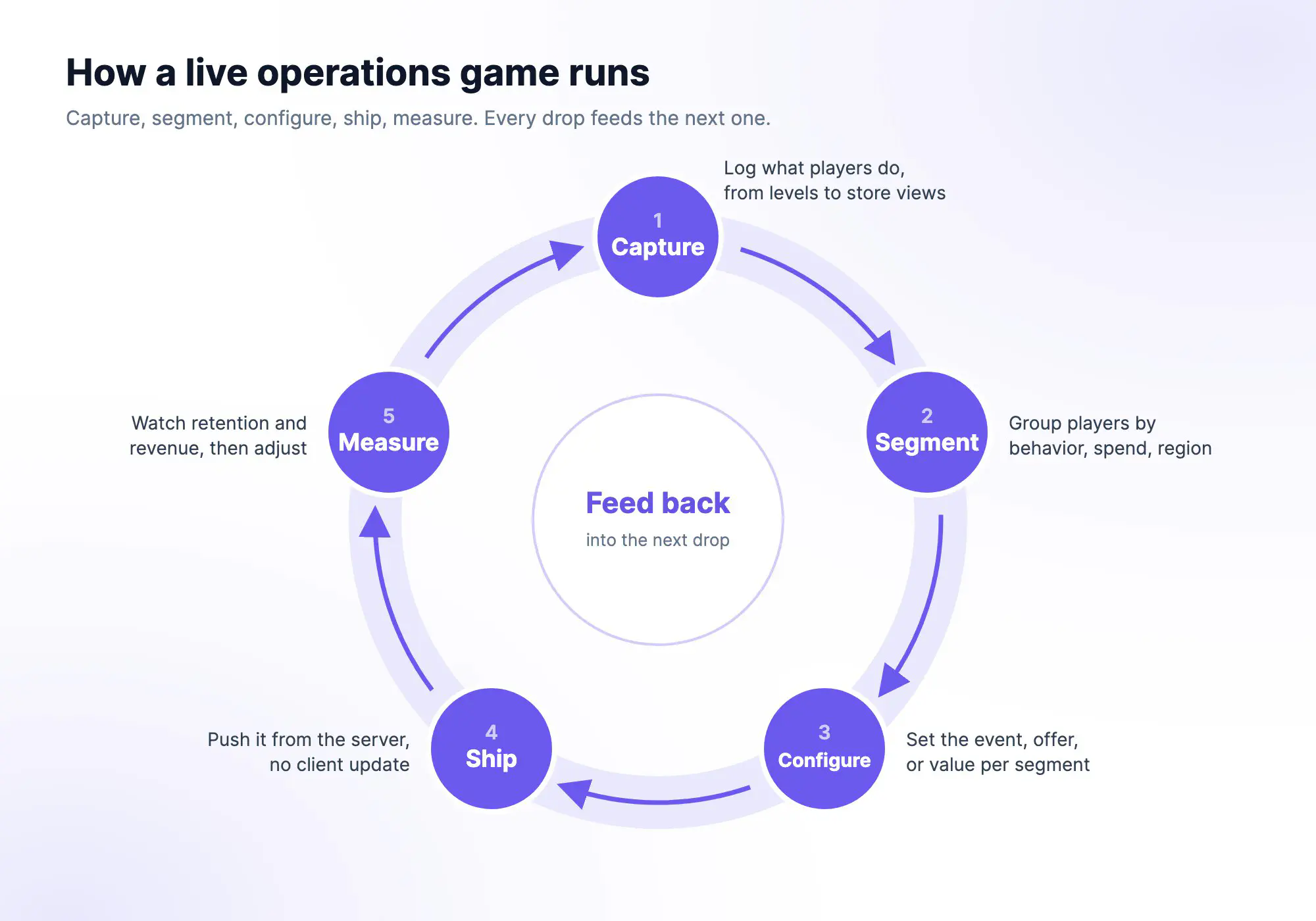
Cadence is the drumbeat of a live game. Players return for events, not for the same menu they saw at launch. A live operations game runs a loop, not a launch. Here is the loop, with a game example at each step.
- Capture events. Log what players do, from level completes to store views. A match-three game tracks where players stall on a hard level.
- Segment players. Group them by behavior, spend, or region. You separate day-one spenders from lapsed returners.
- Configure the change. Set the event, offer, or tuning value for each segment. A weekend double-reward event targets lapsed players only.
- Ship it live. Push the change to the server with no client update. The event goes live Friday morning across every platform at once.
- Measure and feed back. Watch participation, retention, and revenue, then adjust the next drop. The event lifts week-one retention, so it becomes a monthly fixture.
Remote config
Remote config for games means your game reads its rules from the server, not from values baked into the build. Difficulty, prices, and event timing all live server-side. This is LiveOps without an app store update. You change a value, the server serves it, and every client sees it on the next session. Without it, a broken price or an unbeatable level waits days for store review while players churn out.
Economy sinks
An in-game economy breaks the way a real one does, through too much supply and not enough demand. Every reward is a faucet that pours currency in. A sink is anything that takes it back out, from cosmetic purchases to upgrade costs. Get the ratio wrong and currency inflates, rewards feel worthless, and spend dries up. Designing game economies that survive scale means balancing faucets and sinks as your player base grows, then tuning them live when the data says the balance slipped.
How much does it cost to run a live service game?
The cost of running a live service game is a team plus infrastructure plus content, and it scales with your player count and how often you ship, so there is no single number. The honest way to budget is to size each driver on its own.
| Cost driver | What it covers | Scales with |
|---|---|---|
| People | A live events owner, an engineer for the live game and its backend, an analyst, plus community and support | Audience size and how many events you run |
| Infrastructure | The game backend, database, and hosting that serve every session and event | Concurrent players and regions |
| Content | The events, seasons, and art that feed the calendar | Update frequency |
People come first, and they are the cost that never goes away while the game is live. Infrastructure is where the build-or-buy decision lands. Content is a recurring cost, not a one-time build.
Infrastructure is the line most teams underestimate. As you scale, larger studios and publishers move to a managed enterprise game backend for production operations, multi-region hosting, and compliance, without rewriting the stack. Heroic Cloud runs that path. It gives you dedicated, managed clusters with no DAU, MAU, or CCU limits, so cost tracks the capacity you allocate rather than a surprise bill when one event goes viral.
What stack does a live service game need after launch?
After launch, a live service game needs two layers. It needs a production game backend that handles accounts, data, and multiplayer at scale. On top of that sits a live operations layer for the calendar, the remote config, and the economy, staffed by an ops team.
Whether you build that stack, buy it, or run an open-source core with managed operations is its own decision. We break it down in what a live service game needs to stay live.
This is where our stack fits. The operational layer is Satori, our standalone liveops platform for games that pairs with a Nakama backend. It runs the event calendar, the remote config and experiments, and the segmentation and analytics that this guide describes. Hiro handles the economy and progression layer. It gives you currencies, rewards, and loot tables driven by JSON config. Your faucets and sinks live in config you can tune live. Underneath sits Nakama, our production game backend for accounts, realtime multiplayer, and matchmaking, used by over one million developers. When Remedy launched their co-op shooter FBC: Firebreak, they shipped it on the full Heroic stack, with Nakama matchmaking, Hiro, and Satori LiveOps. Small Impact Games runs Marauders on Nakama across more than 330,000 player accounts. For teams that want the operations handled rather than hosted in-house, Heroic Cloud delivers all of it as managed, dedicated clusters.
The takeaway
Live service games don’t fail because players stopped wanting them. They fail when the operations behind them stop moving. Build the loop, hold the economy, and staff the ops. The same genre that shut Concord down in two weeks will keep your players for years. See what Satori can do for your calendar, config, and experiments. Our team at Heroic Labs can walk you through it.
FAQ
Is live service gaming dying?
What is game LiveOps?
How do you reduce game churn in a live service game?
How often should a live service game update?
Can you change a live game without an app store update?
What breaks a live service game's economy?
Does a small studio need LiveOps, or just big publishers?
Built for live games
See how Heroic Labs helps studios run LiveOps that move retention and revenue.
Walk through Satori: retention and RoAS analytics, audiences, A/B tests, and live events in one LiveOps workflow. Book a demo to see it in action.
- SOC 2 Type II certified
- Audiences, A/B tests & live events in one platform
- Supporting $5B+ in games revenue
