
What LiveOps Actually Requires From Your Backend Infrastructure

Most teams discover what LiveOps requires from their backend about six weeks after launch, when the user acquisition team asks for a weekend event and the answer is “we’d need an engineer and a client patch for that.” That moment, not the load test, is when you find out whether your backend was built for a live service or just for a launch.
LiveOps is not a feature you add. It is an operating model, and your backend either supports it or vetoes it. The single requirement underneath all the others is that you must be able to change the game’s behavior without shipping a new client build, or breaking the one already running. Every studio that misses this learns it the expensive way, because the app store review queue does not care about your event calendar.
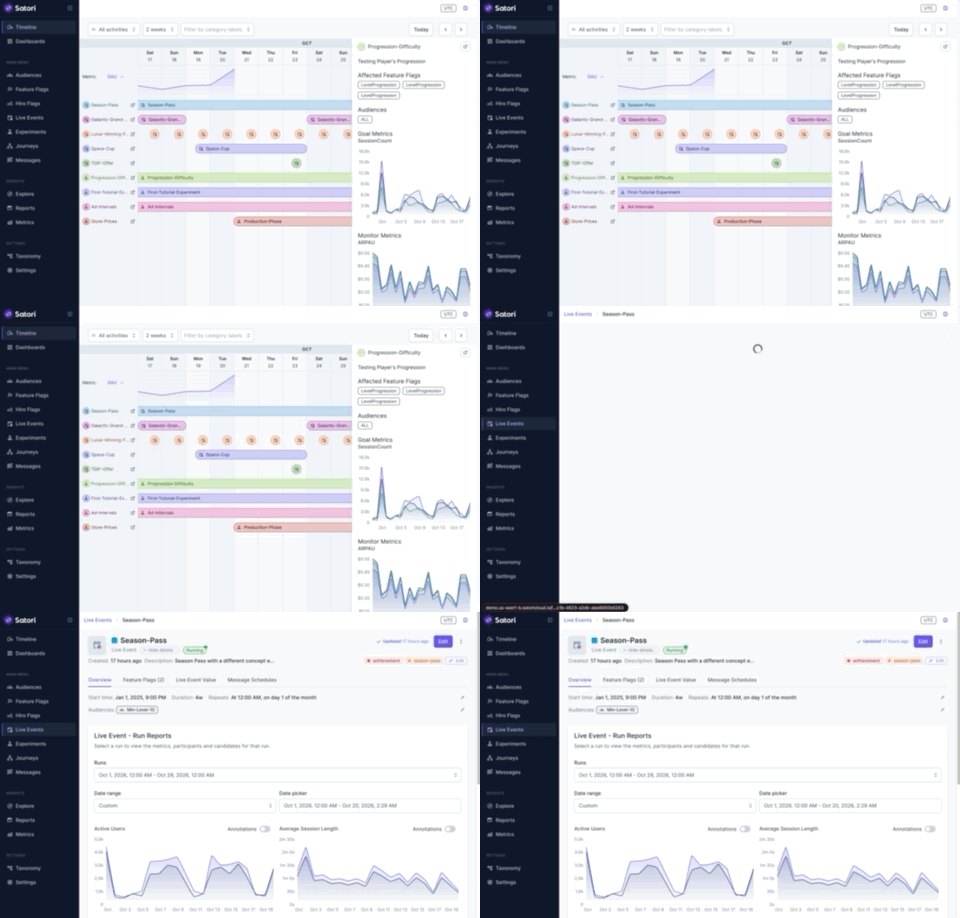
Live games need remote configuration. Prices, drop rates, difficulty curves, feature flags, and event parameters have to live server-side and change at runtime. If a value is baked into the client, it is frozen until the next release, and “the next release” is a two-week round trip through certification.
Well Played Games saw this firsthand on Clans of London. When high-end iOS devices started overheating at 60fps, the team pushed a remote config change to default those devices to 30fps within hours, with no app store approval and no deployment.
"A few years ago, that would have required a new submission to Apple's App Store and a lengthy wait." - Adam Wells, Co-founder, Well Played Games
Live games need scheduling and segmentation. A LiveOps team thinks in cohorts and time windows: this offer, to lapsed spenders, in this region, for 48 hours. The backend has to express that without an engineer translating it into a deployment.
Live games need experimentation. A/B testing is not a nice-to-have once you are tuning an economy with real money flowing through it. The backend has to assign players to variants deterministically, hold them there, and report results you can act on.
Live games need observability that a non-engineer can read. When an event underperforms, the product team needs to see it in hours, not wait for a data pull. LiveOps velocity is capped by how fast you can see what happened, understand why, and act on it.
And underneath all of it, live games need reliability and integrity, because every config change, reward grant, and purchase now happens against live state, with players actively trying to break it.
These requirements are largely undifferentiated. Yes, we build systems like remote configuration ourselves, and we are fully aware that no player has ever loved a game because its remote config system was bespoke. Yet teams routinely spend their best engineers building this layer, then spend the next three years maintaining it instead of building the systems players actually notice.
"What would have taken us three years to build with our own backend, Heroic allows us to build in one year." - Artur Grigorjan, Kwalee
The way we see it, the backend’s job in LiveOps is to enable the team and then get out of the way. Put simply: the measure of a good backend is how rarely the LiveOps team has to ask engineering for permission.
Built for live games
See how Heroic Labs helps studios run LiveOps that move retention and revenue.
Walk through Satori: retention and RoAS analytics, audiences, A/B tests, and live events in one LiveOps workflow. Book a demo to see it in action.
- SOC 2 Type II certified
- Audiences, A/B tests & live events in one platform
- Supporting $5B+ in games revenue
