
What Is Meta Progression in Games? Roguelites, Seasons, and Design

Meta progression is the progress a player keeps when the session ends. It decides whether a lost run, a finished match, or a closed season still feels like a step forward.
What is meta progression in games?
Meta progression is the set of systems that let a player keep progress between sessions, so each session moves a longer arc forward even when the run, match, or level itself resets. Account XP, unlock trees, permanent upgrades, collections, and character mastery are all meta progression. It is the most visible part of a game progression system, and one of the meta game features players notice first.
A useful test: if the player loses everything at the end of the session, what do they still have? Whatever survives is meta progression. In a roguelite, the run is gone but the unlocked weapon stays. In a competitive shooter, the match is over but the account level and the operator mastery badge stay. In a puzzle game, the level is replayable but the map node behind it stays open.
Meta progression sits inside the wider metagame, the layer of systems around core gameplay that persists between sessions. The metagame also includes the economy, social systems, and events. Meta progression is the part that answers one question: what am I building toward?
Meta progression, metagame, and the meta: what is the difference?
Three similar terms get mixed up in search results and design docs. They mean different things.
- Meta progression is mechanical. It is a designed system that persists player progress across sessions, like a permanent upgrade tree or an account level.
- Metagame is the whole layer around core gameplay: progression, the player economy, rewards, social systems, and events. Meta progression is one part of it.
- The meta, in competitive and card-game communities, is the set of strategies the player base currently treats as strongest. It shifts with balance patches and is not a system you build.
- Metagaming in tabletop role-playing means using out-of-character knowledge to make in-character decisions. It is a player behavior, not a game feature.
This guide is about the first one: the progression systems you design, ship, and run.
How does meta progression work in roguelites?
Meta progression roguelites are the classic case. Each run is short and ends in death, and the game resets the map, the build, and the items. What carries over is a currency or resource earned during the run, spent between runs on permanent unlocks.
Two well-known patterns:
- Permanent stat upgrades. In Hades, Darkness collected during runs buys upgrades at the Mirror of Night that apply to every future run.
- Unlocking new options. In Dead Cells, cells collected during a run are spent with the Collector to unlock new weapons and permanent upgrades, and any cells left unspent are lost on death. Later runs start from a wider pool of possibilities.
The design job is to make failure productive. A player who dies on floor two should still bank something toward the next attempt. Done well, meta progression turns a hard game into a learnable one: the player gets better and the character gets stronger, and the two curves meet somewhere around the first clear.
Done badly, it replaces skill. If permanent upgrades do most of the work, the run stops being a test and becomes a grind toward a number. Many roguelites answer this by favoring unlocks that add options (new weapons, new routes, new characters) over flat stat increases.
How is meta progression different from a live-service season?
Meta progression is permanent; a season is time-boxed. In live-service games, a season is a track with a start date and an end date. When it ends, it resets and hands players a fresh goal. Meta progression is the layer underneath that does not reset.
Most live games run both on purpose:
| Meta progression | Seasonal track | |
|---|---|---|
| Lifetime | Permanent for the life of the account | Fixed window, then resets |
| Typical shape | Account level, unlock tree, collection, mastery | Tiered track (often a battle pass), seasonal ranks, event ladders |
| What it rewards | Long-term investment and play history | Activity inside the current window |
| What a returning player sees | Everything they earned is still there | A new track with a fresh starting line |
| Main risk | Ceiling: veterans run out of things to earn | Churn at the reset if the next season is thin |
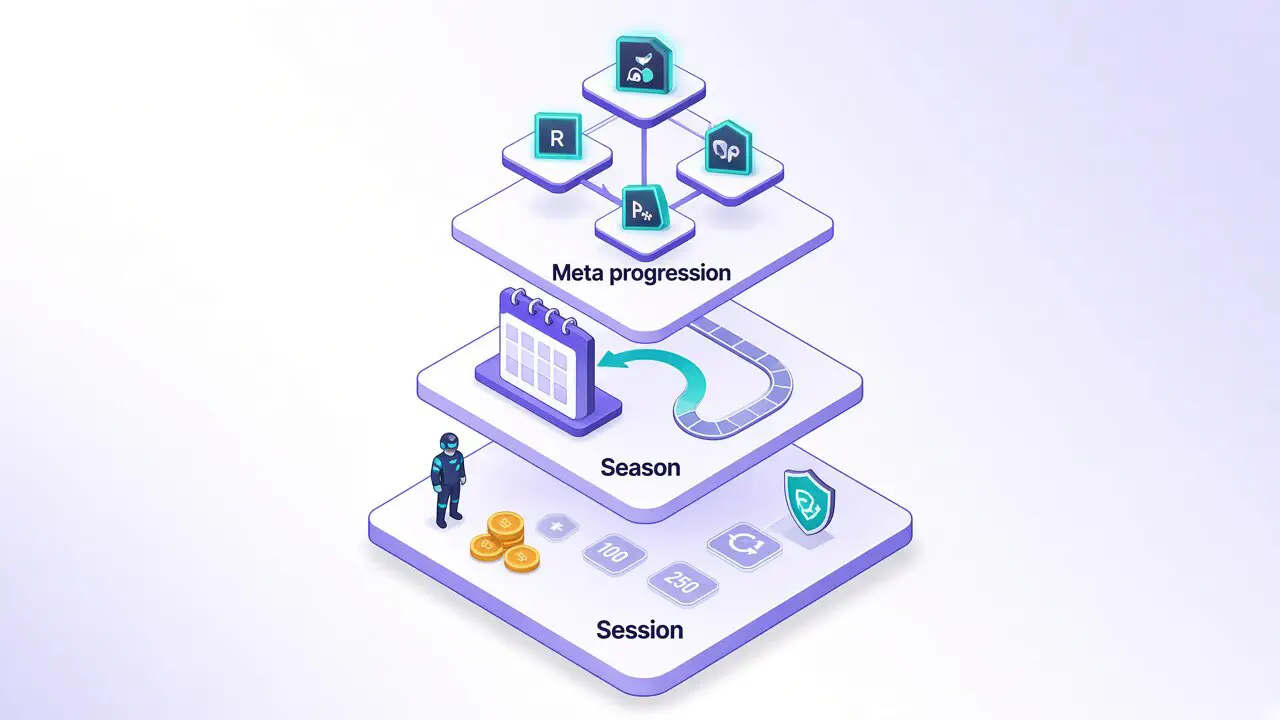
The two layers do different jobs. The seasonal track creates urgency and a reason to return on a known date. Meta progression creates a sense of investment that makes walking away expensive. A season with no meta progression underneath feels like a treadmill: everything resets and nothing accumulates. Meta progression with no seasons tends to flatten out as veterans hit the top.
Game LiveOps is how ops schedules the seasonal layer: events, feature flags, experiments, and calendars. Meta progression is the durable substrate those schedules sit on. The usual pattern is to let the seasonal track pay into meta progression. Season rewards include permanent cosmetics, collection pieces, or mastery progress that survive the reset. The track restarts; what the player earned on it stays.
What are the main types of meta progression systems?
Most meta progression falls into a few shapes. Bigger games combine several.
| Type | What persists | Common in |
|---|---|---|
| Account level / XP | A single number that rises with play and gates features or rewards | Shooters, mobile, MMOs |
| Unlock or tech tree | Nodes the player opens in a dependency order | Roguelites, strategy, skill trees |
| Map or saga progression | Levels or regions opened one after another | Puzzle and casual mobile |
| Collections | Sets of characters, cards, or cosmetics, often with completion rewards | Collectible and gacha games |
| Mastery | Progress tied to a specific character, weapon, or mode | Hero shooters, action games |
| Prestige | A voluntary reset of one track in exchange for a permanent marker or bonus | Idle games, long-running shooters |
A second axis matters more than the shape: vertical versus horizontal progression. Vertical progression makes the player stronger (more damage, more health). Horizontal progression gives the player more options without raising the power ceiling (new characters, new loadouts, cosmetics). Competitive games lean horizontal to protect fairness. Single-player and PvE games can afford more vertical power. Most live games mix both and keep vertical power out of ranked modes.
How do you design meta progression that holds up?
Meta progression game design fails slowly. The common failure modes show up years into a live game, not at launch, so design for them early.
- Pace for the long tail, not the first week. If a dedicated player can max the account in a month, you will spend the next year inventing new tiers. Plan the ceiling, then decide how new content extends it.
- Prefer options over raw power. Every flat stat increase compounds. Unlocks that widen choice age better and keep balance work manageable.
- Give returning players a catch-up path. A player coming back after six months should be able to rejoin within days, not weeks. Catch-up multipliers or a fast lane through older content respect veterans’ time without locking newcomers out.
- Never invalidate earned progress. Rebalancing is normal. Taking away something a player earned is the fastest way to lose trust. Plan migrations so old progress maps cleanly onto new rules.
- Connect seasons to the permanent layer. Seasonal rewards that feed collections or mastery make each season matter after it ends.
- Instrument the curve. Track where players stall on the progression path and where they churn. A stall before a gate is a tuning problem, not a content problem.
What does meta progression need from a game backend?
Meta progression is player state, and player state belongs on the server. A progression path the client can write to is one anyone with a memory editor can max out, and in games with trading, ranked play, or purchases, that becomes an economy and fairness problem.
A game backend for meta progression needs to handle a few jobs:
- Authoritative grants. XP, unlocks, and rewards are granted by server logic after it validates the action that earned them.
- Persistence across devices. Progress lives with the account, not the install, so a player who switches phone or platform keeps everything.
- Rules as configuration. Unlock costs, XP curves, and preconditions change often after launch. Keeping them in server-side configuration means you can retune without shipping a client update.
- Schedules. Seasonal tracks, recurring challenges, and event ladders need start times, end times, and reset logic the server enforces.
- Safe migrations. When the progression model changes, existing player state has to carry forward without loss.
For publishers running several live titles, the same systems repeat across the portfolio. That is where a shared progression backend pays off: one model for accounts, unlocks, and schedules, configured per game instead of rebuilt per game. A change to XP curves, unlock costs, or season schedules then ships as configuration rather than a new build for each title.
Where Heroic fits
We built Hiro for exactly this layer. Hiro is our metagame framework built on Nakama, our open-source game backend, and it covers meta progression with configurable systems instead of custom server code.
- Progression works as a dependency tree for skill trees, tech trees, and saga maps. A node can require completed achievements, owned items, minimum stats, or currency, and progressions can gate other progressions. Each progression can also carry a reset schedule.
- Achievements handle milestones and recurring goals. A parent achievement with sub-achievements per tier forms a battle pass track, with rewards per tier and an optional completion reward.
- Stats, Inventory, and Rewards hold the persistent player state that progression gates check against.
On the LiveOps side, Satori schedules live events, including repeated series like season passes, and targets them to audiences. Through the Hiro personalizer, Satori can override Hiro configuration per player, so you can test a gentler XP curve on one audience without a client release.
Halfbrick used this approach when it rebuilt Magic Brick Wars on Nakama and Hiro in nine weeks, cutting 75% of the previous backend codebase. The team built its progression system with Hiro’s Player Stats, Rewards, and Unlockables, so players unlock new content and abilities as they play. Read the Halfbrick story. Named studios that have publicly disclosed Hiro’s Progression system include Invincibles Studio (Inventory, Economy, Progression on the Soccer Manager series).
For publishers and large studios, Heroic Cloud runs the same stack as a managed service, with multi-region deployment, so progression state for every title sits on infrastructure you don’t have to operate yourself.
FAQ
What is meta progression in games?
What is meta progression in roguelites?
How is meta progression different from a live-service season?
What is the difference between meta progression, the metagame, and the meta?
Is a battle pass meta progression?
Does meta progression need a server?
Enterprise metagame systems
See how studios ship economy, progression, and social systems without rebuilding them.
Walk through Hiro on Nakama: rewards, inventories, currencies, and event systems your team can configure and ship faster. Book a demo to see it in action.
- SOC 2 Type II certified
- Production-ready economy & progression modules
- Supporting $5B+ in games revenue
