
What Is a Meta Loop in Game Design? Core Loops, Sessions, and Seasons

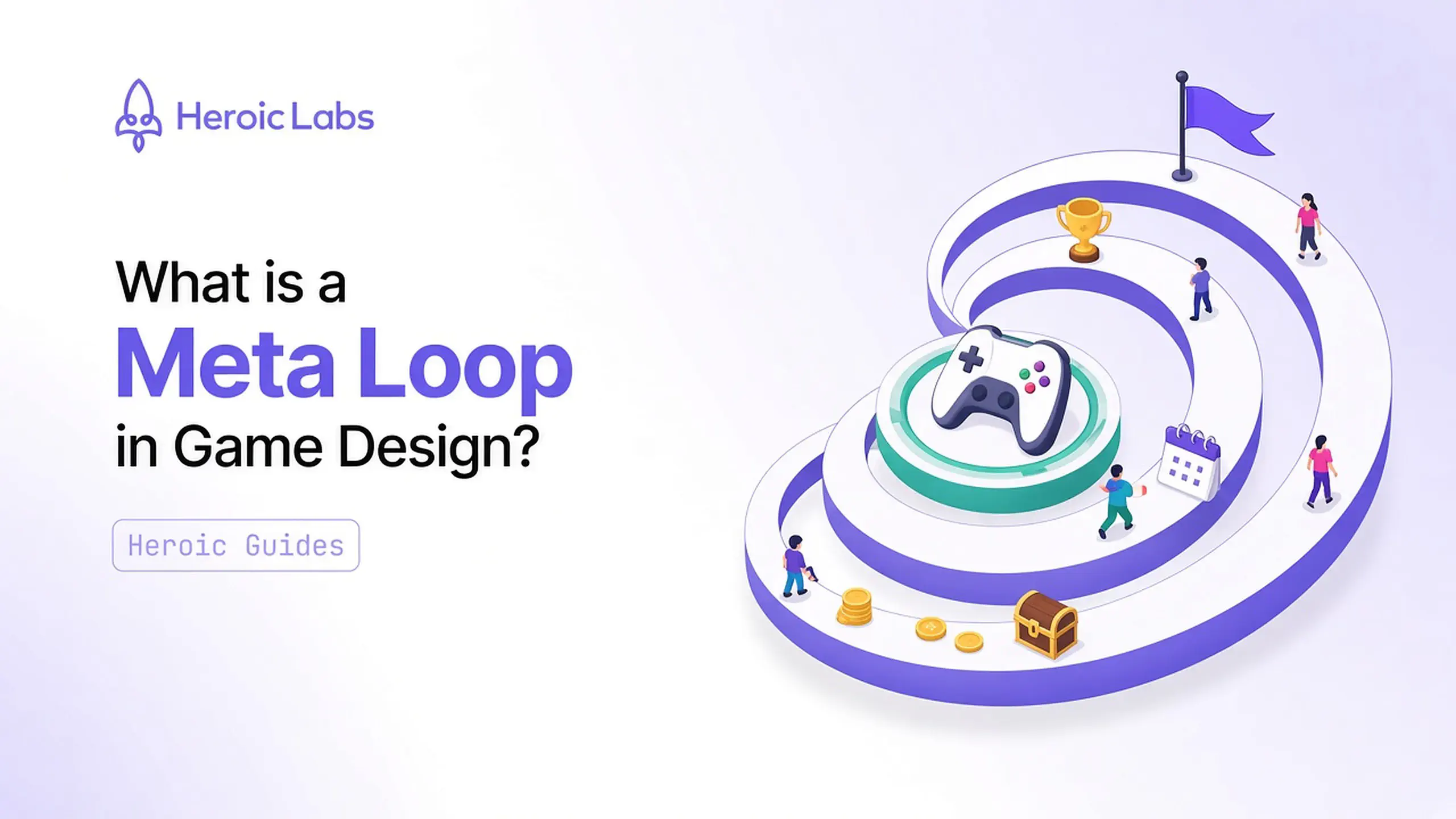
The core loop makes a session fun. The meta loop is why the next session starts. Here is how the two connect, and how one sitting turns into a season.
What is a meta loop in game design?
A meta loop is the repeating cycle that takes what a player earns in the core loop and turns it into longer-term progress: currency spent on an upgrade, XP banked toward a level, a piece that completes a collection. That progress changes the next session, so the player starts again with a new goal or a new option. The core loop runs inside one session. The meta loop runs across many of them. The core loop is a circle you repeat. The meta loop is a spiral that grows each time you come back.
| Layer | Timescale | What the player is doing | What powers it |
|---|---|---|---|
| Core loop | Seconds to minutes | Playing the current match, level, or run | The game client and game server |
| Meta loop | Days to seasons | Building toward the next goal, like banking currency or climbing a track | Server-side progression, economy, and schedules |
The term names the hand-off. A match, a level, or a run produces something, and the meta loop decides what it is worth. If the answer is “nothing”, nothing pulls the player back. If the answer is “one step closer to the thing you want”, the player queues again.
The meta loop is one part of the wider metagame, the layer of systems around core gameplay that persists between sessions. For the full map of those systems, see our guide to what is meta game design. This piece zooms in on the loop itself: how it connects to the core loop, and how it stretches from one session to a season.
What is a core loop in games?
A core loop is the moment-to-moment cycle a player repeats inside a session: act, get a result, act again. In a shooter it is engage, win or lose the fight, reposition. In a match-3 game it is swap, clear, cascade. In a roguelite it is clear a room, pick a reward, move to the next room. The core loop is what the player’s hands are doing, and it has to be satisfying on its own.
The core loop and meta loop are two halves of one system. The core loop produces coins, XP, drops, and score. The meta loop consumes them through the store, the upgrade tree, the account level, and the collection book. A good core loop with no meta loop feels pointless after a few hours. A deep meta loop on a weak core loop feels like a chore list.
A quick test separates them. Ask what resets when the session ends. Whatever resets belongs to the core loop. Whatever carries over belongs to the meta loop.
How does the core loop feed the meta loop?
The core loop feeds the meta loop through a simple chain: play produces a resource, the resource buys progress, and the progress changes how the next session plays. Every live genre runs some version of it.
| Genre | Core loop (one session) | What it produces | Meta loop (across sessions) | What changes next session |
|---|---|---|---|---|
| Match-3 / puzzle | Clear a level | Coins, stars, boosters | Spend stars to restore a map area; buy boosters | New levels open; harder boards come with better tools |
| Competitive shooter | Play a match | Account XP, weapon XP, battle pass progress | Level up, unlock attachments, climb the pass | New loadout options and a visible next tier |
| Roguelite | Attempt a run | Run currency kept after death | Buy permanent unlocks between runs | A wider choice of weapons, routes, or characters |
| Strategy / base builder | Raid or defend | Resources, plus troops won and lost | Upgrade buildings and research | A stronger army and new unit types to plan around |
Two details make the chain hold. The last column has to be real: meta loops that last change a decision in the next session, like which loadout, route, or board to attempt. And the conversion has to be legible, so players see at the end of a session roughly how far it moved them.
This is also where the loop meets the economy. Every resource the core loop produces is a source, and every upgrade or purchase on the meta side is a sink. When sources outrun sinks, rewards stop meaning anything. Our metagame design guide covers economy balance in depth. The short rule: never produce something the meta loop has no use for.
How do sessions connect to seasons in live games?
Sessions connect to seasons through nested clocks. A live game does not run one meta loop. It runs several on different cadences, and each one takes the output of the shorter one. The four common clocks are the session, the day, the week, and the season.
| Clock | What closes | Typical meta loop | What it hands to the next clock |
|---|---|---|---|
| Session | A match, level, or run | Earn and spend in a few minutes | Resources and progress toward daily goals |
| Daily | A login, a set of tasks, an energy tank | Daily quests, login streaks, energy refills | Streak progress and weekly points |
| Weekly | An event or league window | Event leaderboards, guild goals, weekly challenges | Rank, rewards, and season track progress |
| Seasonal | A season or battle pass | A tiered track and seasonal ladder that reset on a schedule | Permanent rewards that stay on the account |
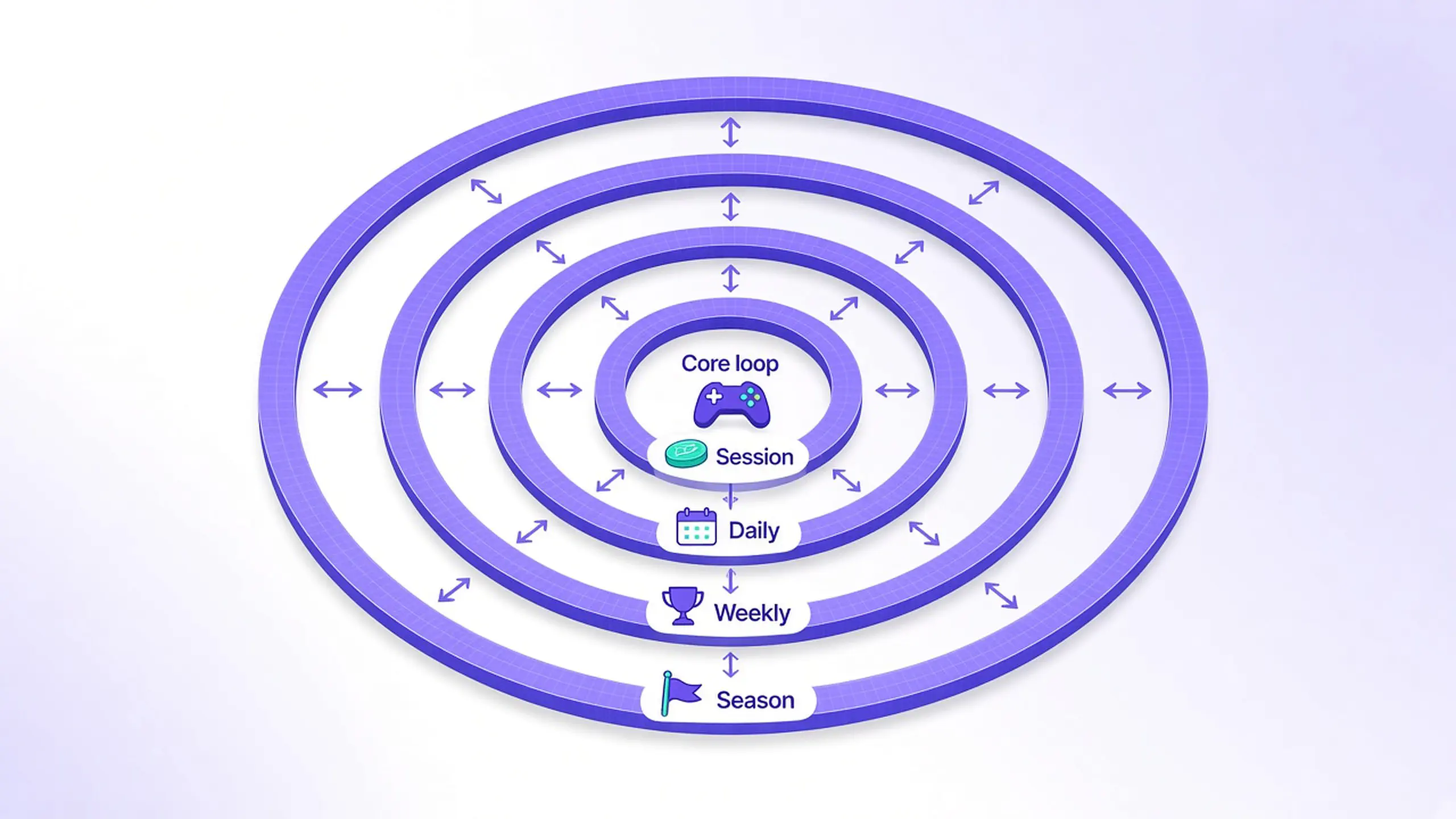
The connection is what keeps a session from feeling small. A ten-minute match matters more when it also completes a daily quest, which feeds the weekly event, which pushes the player up the season track. Each clock is a different reason to return: a daily habit, a known day for lapsed players, and a fresh starting line every season.
Resets are the design lever. A season that resets everything feels like a treadmill. A season that resets nothing flattens out once veterans hit the ceiling. Most live games reset the seasonal track and keep what the player earned on it, like cosmetics, collection pieces, or mastery, so every season leaves something behind.
What makes a meta loop work?
A meta loop works when each session visibly moves a longer goal and that goal changes how the player plays. Run any design against these checks:
- Every core output has a meta use. If a currency, drop, or score has nowhere to go, it is noise.
- The next goal is always visible. At the end of any session, the player knows what they are working toward and roughly how far away it is.
- Progress changes decisions, not only numbers. Unlocks that add options (a new character, route, or loadout) age better than flat stat increases.
- Cadences differ in reward and reset. Daily, weekly, and seasonal loops that pay the same reward on the same schedule read as one loop with extra steps.
- Losses still count. A failed run or a lost match should still bank something, or the meta loop punishes the players most likely to quit.
- Tuning does not need a patch. Drop rates, refill timers, and track pacing change constantly after launch. If each change waits on an app-store release, the loop goes stale.
The common failures mirror the list. A disconnected loop hands out currency with nothing worth buying. An overbearing one lets power or purchases replace skill, so the core loop stops being a test. A single-cadence one gives players one reason to return instead of four.
What does a meta loop need from a game backend?
A meta loop is player state that changes every session, and in any online game that state belongs on the server. If the client can write to its own wallet, XP, or unlocks, anyone with a memory editor can skip the loop. With ranked play, trading, or purchases, that becomes a fairness and revenue problem.
A game backend that runs meta loops needs to:
- Grant on the server. XP, currency, and unlocks are awarded by server logic after it validates the action that earned them.
- Enforce the clocks. Daily resets, weekly windows, and season end dates run on server time, not the device clock.
- Keep rules in configuration. Costs, curves, and reset schedules live in server-side config so designers can retune them live.
- Persist across devices. Progress follows the account, so a player who switches phones keeps every streak and tier.
For publishers, meta loops are portfolio infrastructure: wallets, quests, and season tracks repeat in every live title. A shared game progression system on one backend lets each title configure its own loops instead of rebuilding them.
Where Hiro and Satori fit
We built Hiro for this layer. Hiro is our metagame framework built on Nakama, our open-source game backend. It ships the meta game features that meta loops run on as configurable systems rather than custom server code. Mapped to the clocks above:
- Session hand-off. Economy, Inventory, and Rewards turn core loop outputs into currencies, items, and grants, all on the server.
- Daily and weekly loops. Energy paces sessions with refill timers. Streaks reward consecutive play. Achievements can recur on a schedule for daily and weekly quests, and Event Leaderboards run time-limited competitions that reset on a cadence.
- Seasonal loops. Achievements with tiered sub-achievements form a battle pass track, and Progression can carry its own reset schedule.
Gram Games built the daily layer of FruitFall! this way. Daily Login Bonuses run on Hiro Streaks with a five-day consecutive target. Lives and the Challenge Mode energy timer run on Energy. The daily challenge mode and the Butterfly Event run on Achievements.
Our own demo game, Mage Mayhem, runs the session and daily clocks end to end on Hiro and Nakama. Players clear a timed arena, earn gold to buy gear, compete on daily leaderboards, build win streaks, and spin a reward wheel gated by regenerating energy.
Satori is the LiveOps half. It schedules live events, including repeated series like season passes, and targets them to audiences. Through Satori’s Hiro integration, every Hiro system becomes remotely configurable in the Satori console. A team can test a faster season track or a gentler energy refill on one audience without a client release. For how that ops loop runs, see what is game LiveOps and our guide to player engagement.
For publishers and large studios, Heroic Cloud runs the same stack as a managed service with multi-region deployment, so every title’s meta loops run on infrastructure you don’t have to operate yourself.
FAQ
What is a meta loop in game design?
What is a core loop in games?
What is the difference between a core loop and a meta loop?
How do sessions connect to seasons in live games?
Is the meta loop the same as the metagame?
Is a battle pass a meta loop?
Does a meta loop need a game backend?
Enterprise metagame systems
See how studios ship economy, progression, and social systems without rebuilding them.
Walk through Hiro on Nakama: rewards, inventories, currencies, and event systems your team can configure and ship faster. Book a demo to see it in action.
- SOC 2 Type II certified
- Production-ready economy & progression modules
- Supporting $5B+ in games revenue
