
What Is a Game Backend? A Developer's Guide

A guide to the server side of your game, from player accounts to realtime multiplayer.
A game backend is the server-side part of your game: the software that runs on a server instead of the player’s device and controls accounts, saved progress, and multiplayer sessions. If the game engine draws the world on screen, the backend is everything that happens on the server once players connect to each other. People also call it a game backend platform or a game backend as a service. The moment your game needs a login, a leaderboard, or two players in the same match, you need one.
That’s the short version, and the plain meaning of a game backend. Here’s what it actually does.
What does a game backend do?
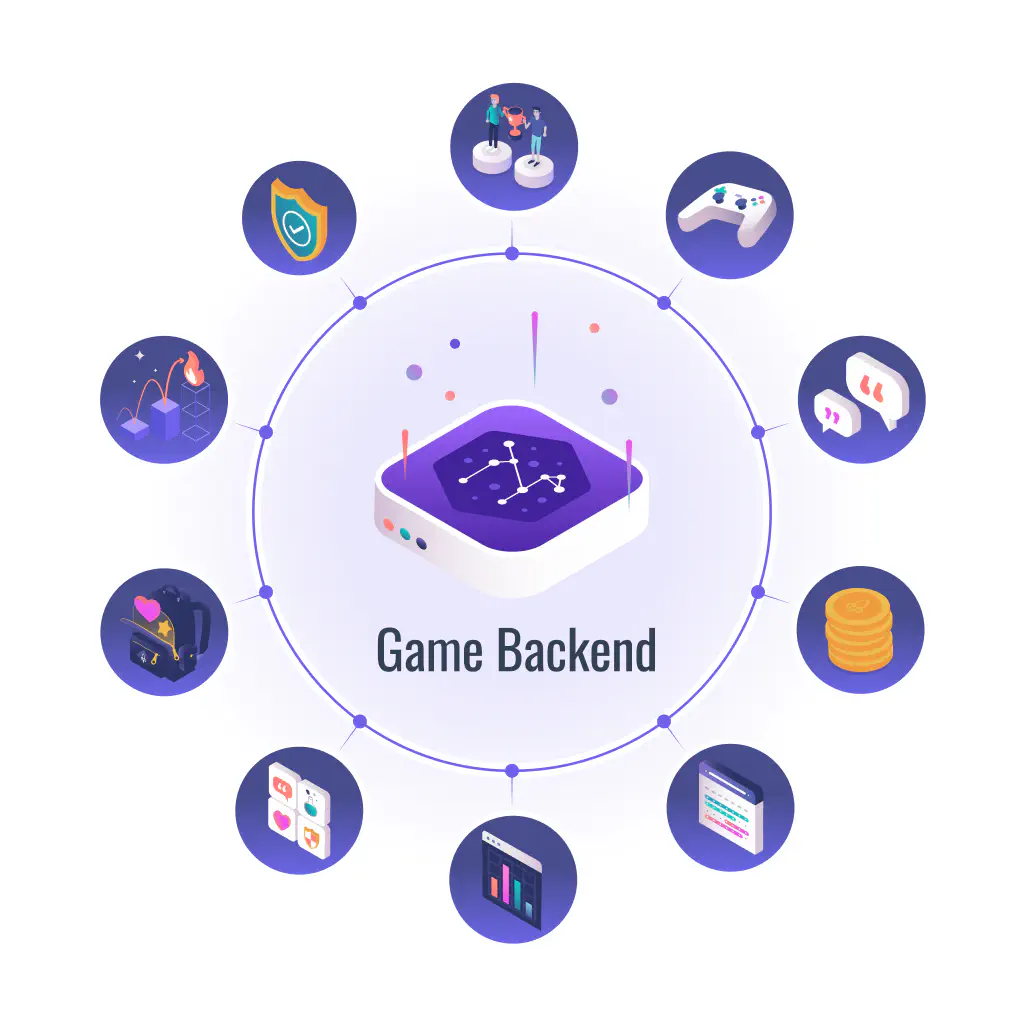
A game backend runs the services your game can’t keep on the device, from player accounts and saved data to realtime multiplayer and matchmaking. It’s the shared source of truth that every player connects to.
Break it into the pieces you’ll actually build against:
- Authentication. Sign players in with email, device, or a social account, then keep their identity consistent across devices. Here’s how we handle authentication in Nakama.
- Storage and player data. Save progress, inventories, and game state on the server so a lost phone doesn’t mean a lost account.
- Realtime and turn-based multiplayer. Put players in the same session, sync their actions, and keep the match state consistent.
- Matchmaking. Group players into matches by skill, latency, or any rule you set.
- Leaderboards and tournaments. Rank players and run scheduled competitions to bring them back.
- Social systems. Friends, clans, and in-game chat. Presence and notifications come built in.
- Custom server logic. Your own code, running on the server, to validate moves and enforce the rules of your game.
You don’t need every piece on day one. A single-player mobile game might only want accounts and cloud saves. A competitive shooter needs matchmaking, authoritative multiplayer, and anti-cheat from the start.
How does a game backend work?
The client on the player’s device opens a connection to the backend, and the backend handles anything that has to be shared or trusted. For realtime play, that connection stays open so data flows both ways with low latency, the same model WebSockets use on the web. That persistent, two-way connection is what lets a multiplayer game backend keep every player’s view of the match in sync.
There are two common models for the multiplayer part, and the difference matters:
- Authoritative multiplayer. Your game loop runs on the server. The server has the final say on every move, so it can validate input and shut down cheating. This is what competitive and server-driven titles need. With our Nakama you can run authoritative matches at a configurable tick rate. Turn-based games run at about one tick per second, and fast-paced games run at dozens per second.
- Relayed multiplayer. The server relays messages between trusted clients with very low overhead. It’s lighter, fast to stand up, and fits games where you trust the client.
| Authoritative | Relayed | |
|---|---|---|
| Authority | Server has the final say. It validates every message and broadcasts state. | Clients hold authority. The server forwards messages without inspecting them. |
| Latency | Higher. Input runs through the server game loop before it reaches other players. | Lower. The server routes messages straight to the other clients. |
| Anti-cheat | Strong. The server enforces the rules, so bad input gets rejected. | Weak. There’s no cheat detection. One client acts as host to arbitrate. |
| When to use | Competitive play, higher player counts, and games where you can’t trust the client. | Simple 1v1 or co-op where cheating isn’t a factor and you trust the client. |
Underneath both models, the backend reads and writes to a database and can call out to other services you depend on. That’s the “how it works” behind “game backend explained”: a server your clients trust, holding the state that no single device can be trusted to hold.
Where our Nakama fits as a game backend platform
Our Nakama is an open-source game backend that 1 million developers build on, and it covers that whole list from a single server. Authentication, multiplayer, and matchmaking run in one place. Leaderboards, chat, and storage sit right next to them. You write server logic in Go, TypeScript, or Lua. You get direct database access, with no black-box in the way.
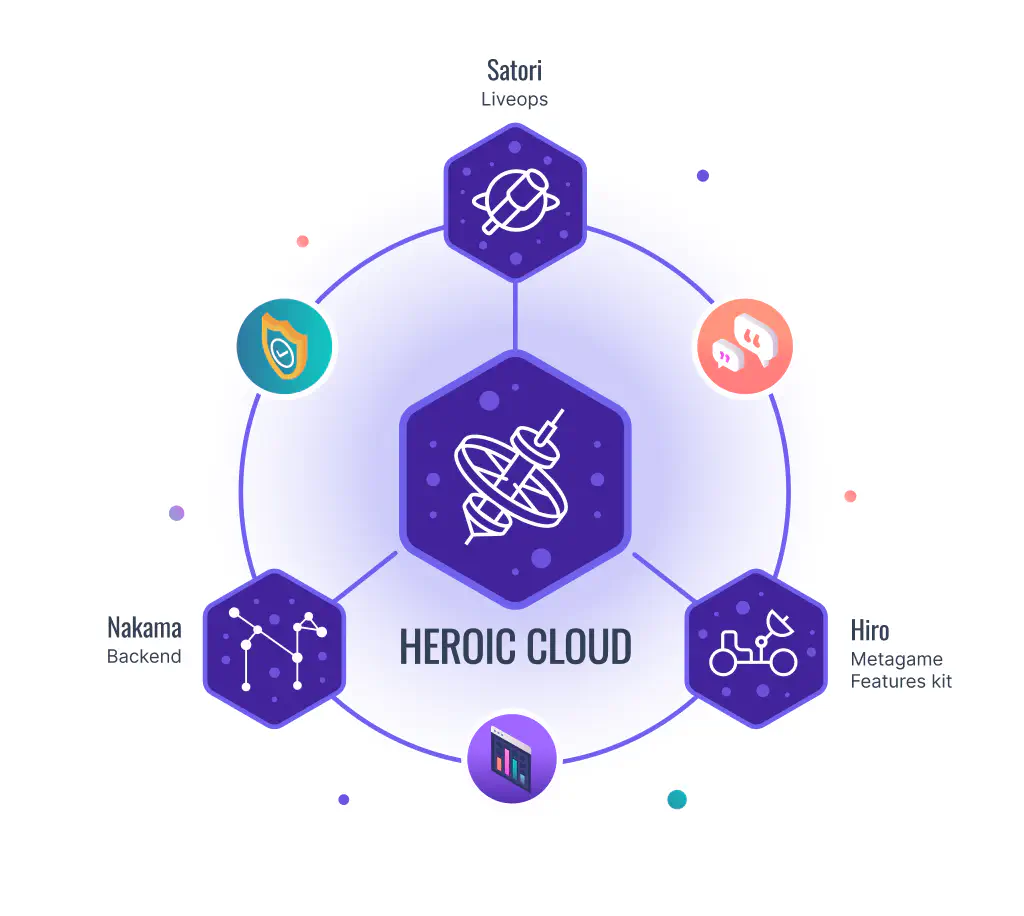
The reason we build it open source is ownership. The core is Nakama, licensed under Apache 2.0, so you run it yourself and your data stays yours. When you want more, the stack is composable. Hiro adds economy, energy, and reward systems on top. Need LiveOps? Satori handles segmentation, live events, and experiments. And when you’d rather not run servers yourself, Heroic Cloud gives you managed hosting. For larger studios, publishers, and enterprise teams that need production ops and scale without operating the stack themselves, Heroic Cloud is the managed path. Take only the pieces you need.
This isn’t a small-scale toy. We’ve developed Nakama since 2015. It serves more than 1 trillion requests a month and has been tested to 2 million concurrent users. Titles built on it include Pixel Flow, a breakout hit with more than 10 million players. Start from the Nakama docs if you want to install it and see for yourself.
Do I need a game backend?
You need a game backend the moment your game does anything online: accounts, cloud saves, or two players interacting in real time. A purely offline, single-player game with no shared data can skip it. Almost everything else needs one.
| Feature | Backend needed? |
|---|---|
| Cross-device player accounts | Yes |
| Cloud saves and progress sync | Yes |
| Real-time or turn-based PvP | Yes |
| Global leaderboards and tournaments | Yes |
| Offline single-player, local saves only | No |
The real decision is build versus buy. Build it yourself and you own every edge case in auth, matchmaking, and scaling before you ship the features that make your game yours. Buy a platform and those problems are already solved, so you spend time on gameplay.
| Build in-house | Buy a platform | |
|---|---|---|
| Time to ship | Slower. You build auth and matchmaking before gameplay. | Faster. Core services work on day one. |
| Ops burden | You run and scale everything. | A host can run it for you. Self-host and you still do. |
| Customization | Change anything. | High with open source. Limited with closed platforms. |
| Lock-in | None. The code is yours. | Low with open source. Higher with proprietary. |
The options fall into three broad types.
- Open-source self-host. You run the backend on your own infrastructure and keep full control of the code and the data. It takes ops effort, but nothing sits behind another company’s platform.
- Managed game BaaS. A vendor hosts the backend and you build against their APIs. You start fast and skip running servers, and you give up some control and portability in return.
- Engine-tied cloud. Backend services bundled with a game engine’s ecosystem. Convenient if you already build in that engine, with the tradeoff of tighter coupling to one vendor.
Open source splits the difference. You get a backend that works out of the box, and you still own the code and the data, so you’re never locked into someone else’s roadmap or pricing.
FAQ
What is a game backend in simple terms?
What's the difference between a game backend and a game engine?
Is a game backend the same as a game server?
Is Nakama free to use?
Enterprise game backends
See how studios ship multiplayer at scale without rebuilding infrastructure.
Walk through Nakama and Heroic Cloud: org-level access control and managed ops without rewriting your stack. Book a demo to see it in action.
- SOC 2 Type II certified
- Proven at 2M concurrent users
- Dedicated capacity, no CCU limits
