
What Is a Battle Pass in a Live Service Game? Tiers, Tracks, and Seasons

A plain definition of the battle pass, how its tiers and seasons work, and the backend and LiveOps a pass needs to run season after season.
What is a battle pass in a live service game?
A battle pass is a time-limited reward track that players climb by playing during a season. Each match, quest, or challenge earns pass XP. Enough XP unlocks the next tier, and each tier pays out a reward. When the season ends, the track closes and a new one starts. In short, a battle pass is a seasonal progression track with a fixed start and end, tiered rewards, and a reset.
Most passes split into two tracks. The free track is open to every player and pays out a handful of rewards. The premium track costs a one-time purchase per season and unlocks richer rewards on the same tiers, usually cosmetics, currency, and seasonal items.
Dota 2 introduced an early version, the Compendium, around its The International tournament in 2013. Epic made the format mainstream when it added a purchasable battle pass to Fortnite in 2017. Today it shows up across shooters, battle royales, mobile puzzle games, and sports titles.
Battle pass and season pass. In a live service game, “season pass” and “battle pass” usually name the same system: a seasonal track with tiers and rewards. In premium boxed games, though, a season pass often means an upfront bundle of future paid DLC.
How does a battle pass work?
Every battle pass is built from the same handful of parts.
| Part | What it does | Example |
|---|---|---|
| Season window | Sets when the pass opens and closes | An 8-10 week season |
| XP sources | Turn play into pass progress | Matches, daily and weekly challenges, events |
| Tiers | Numbered steps, each with an XP threshold | Tier 1 to tier 100 |
| Free track | Rewards every player can earn | Currency, a few cosmetics |
| Premium track | Rewards unlocked by a seasonal purchase | Skins, emotes, seasonal items |
| Completion reward | A bonus for finishing the whole track | A final-tier exclusive |
| Reset | Closes the track and starts the next season | Progress returns to tier 1 |
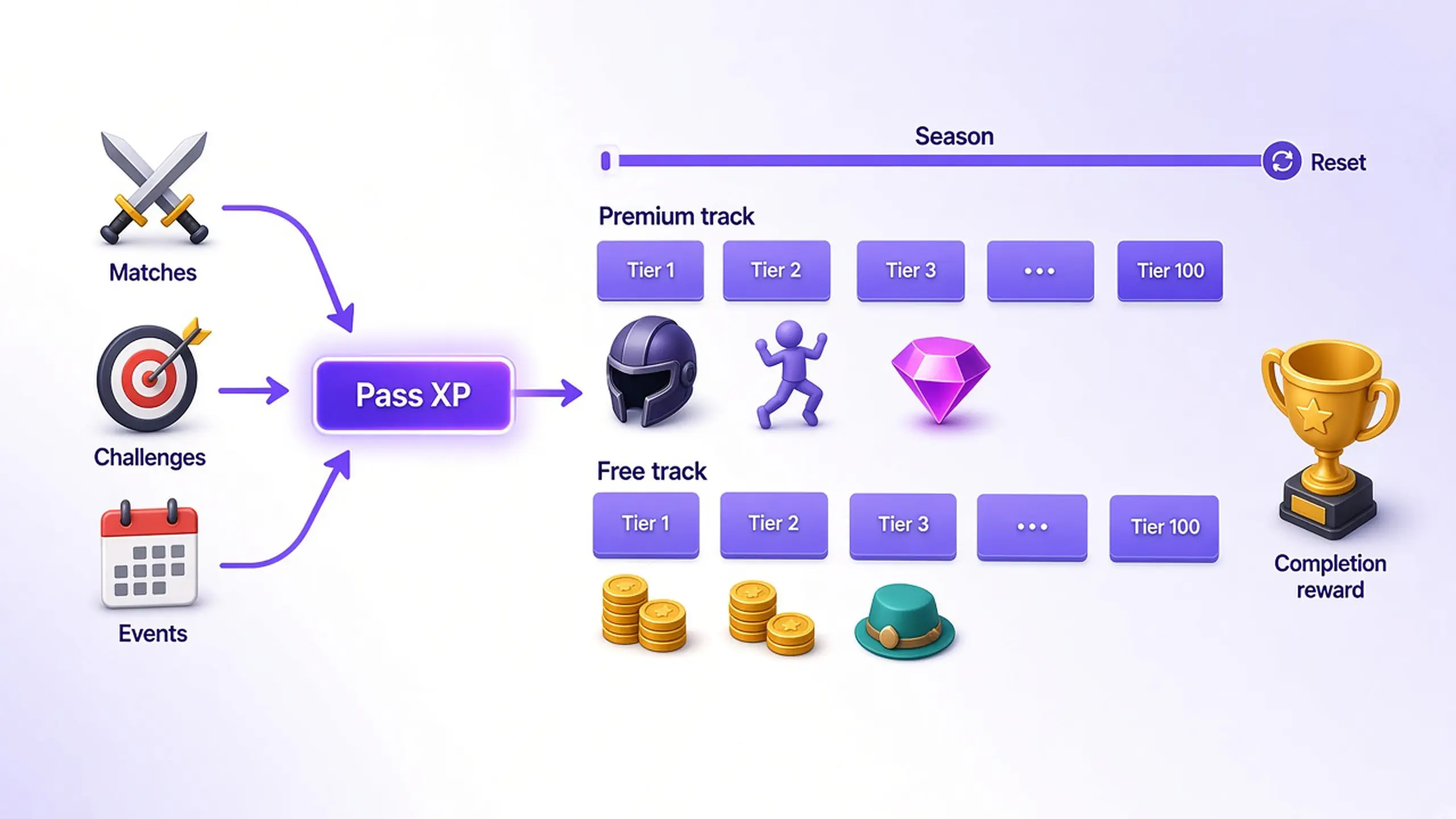
The core loop feeds the pass. Here is the path one reward takes:
- A player clears an objective. In a battle royale, they finish a match in the top ten.
- The server validates it and writes XP to the ledger. Nothing is trusted from the client.
- The total crosses a tier threshold. The next tier unlocks.
- The server grants the tier’s reward. It lands in the player’s wallet or inventory. Free players get the free-track item, and premium owners get both.
When the season ends, the track resets, but the skins and items players earned stay on the account. That split makes a battle pass the link between the session and the season: the track is seasonal, while the rewards become long-term collection. Our metagame design guide covers how that seasonal loop sits inside the wider metagame.
Why do live service games use a battle pass?
A battle pass solves two live-service problems at once: giving players a reason to come back, and earning revenue that does not depend on random purchases.
Retention with a clock. A pass gives every session a visible goal and every season a deadline. Players three tiers from a reward they want will log in to finish it. The reset gives lapsed players a clean moment to return.
Predictable monetization. A premium track is one clear purchase per season. Players know exactly what they get, which makes it an easier buy than a loot box. For the studio, each season becomes a repeatable revenue beat rather than a one-time spike.
A frame for content. A season gives the LiveOps calendar its shape. New modes, maps, events, and store items hang off the season theme, and the pass ties them together with one progress bar.
A battle pass belongs to the live service layer, not the store. For the wider picture, see what is a live service game.
How do studios design a battle pass?
Battle pass system design is mostly a pacing problem. The goal is a pass that feels like progress, not a second job.
- Season length. Longer seasons ease pressure but slow the content cadence. Shorter seasons keep things fresh but demand more content and ops work.
- XP curve. Decide how many hours an engaged player needs to finish the track, then work backward to XP per tier. For example, take a 10-week season with 100 tiers and a target of about 40 hours for an engaged player. That works out to roughly 24 minutes of play per tier on average. Make tiers 1-20 cheaper so a new player clears several in the first session, then hold the remaining tiers at a flat cost so the last week never turns into a wall.
- XP sources. Balance passive XP from normal play against challenge XP. Too much challenge XP forces players into modes they do not enjoy. Too little makes challenges pointless.
- Free vs premium value. The free track must feel worth climbing on its own. The premium track should feel like clear value for the price, without locking power behind the purchase.
- Catch-up. Players who join mid-season need a path to the end: XP boosts in the second half, bonus weekly challenges, or tier purchases.
- What carries over. Decide which rewards stay on the account and which progress resets. Permanent cosmetics build long-term collection. A clean track reset keeps each season fair.
Common battle pass design mistakes
- Pay-to-win premium tiers. Gameplay power on the premium track splits the player base and erodes trust in competitive modes.
- A grind wall. Late tiers that need far more XP than early ones push players to quit the pass, not finish it.
- FOMO as the whole pitch. Urgency helps, but a pass that only works through fear of missing out burns players out across seasons.
- Hardcoded tiers. If XP values and rewards live in the client, every balance fix waits on an app store update.
What does a battle pass need from a game backend?
A battle pass looks like UI, but almost all of it is server work. It is a progression and reward system with real money attached, so the game backend has to own it.
| Need | Why it matters |
|---|---|
| Server-side XP ledger | Clients can be tampered with. The server records pass progress and grants tiers, not a number sent by the client. |
| Purchase validation | The premium track is bought with real money. The backend validates the receipt before unlocking premium rewards. |
| Reward grants | Each tier pays into the player’s wallet or inventory, exactly once, even if a player retries a claim. |
| Season schedule | The pass needs a start time, an end time, and a reset that runs for every player on time. |
| Unclaimed rewards at reset | Players who finished a tier but did not claim it should still get the reward when the season rolls over. |
| Remote configuration | Tiers, XP values, and rewards change from the server, so you can tune mid-season without a client release. |
| Scale at season launch | A new season brings a rush of returning players. The backend has to absorb that spike without downtime. |
| Event data | Tier completion, XP per session, and premium conversion tell you whether the pass is paced well. |
This is where a battle pass backend earns its keep. Under the menu, a battle pass is a game progression system with a clock, a store, and a reset. On a live service game backend that already handles progression, rewards, and schedules, the pass becomes configuration.
A game tournament system, such as timed tournaments and leaderboards, often runs inside the same season and awards pass XP, so it should share the season’s schedule and reward pipeline.
How do you run a battle pass as part of LiveOps?
Running the pass well, season after season, is LiveOps work.
During a season, watch tier completion by week. A cliff at one tier means the XP curve is too steep there. Watch premium conversion by audience, too: new, returning, and long-time paying players respond to the pass differently.
Then act on it. Add bonus XP weekends when progress stalls. Offer catch-up challenges to players who are behind. Because the pass runs on server configuration, this is LiveOps without an app store update. It is the same LiveOps loop studios use for any live event: capture, segment, configure, measure, and iterate. Our guide to player engagement covers how that loop drives return visits.
How do Hiro and Satori run a battle pass?
You can build a battle pass yourself, and some studios do. Most teams would rather spend that time on the season’s content than on reset logic and reward ledgers.
Hiro is our metagame framework built on Nakama, the open-source game backend. Its Achievements system covers battle pass tracks directly. A parent achievement acts as the pass, and sub-achievements act as the tiers. Each tier can require the previous one, carry its own reward, and add a completion bonus on the parent. Scheduling fields set when the track opens, how long it runs, and when it resets, and players can still claim completed rewards after a reset. Our docs walk through building a battle pass step by step.
Satori is our LiveOps platform for games. It schedules live events, including repeated series like season passes, and targets them to audiences. Through Satori’s Hiro integration, Hiro configuration becomes remotely configurable per player, so you can test a faster track or a richer free tier on one audience without a client release. Satori also captures the events that tell you whether a season is paced well, such as tier completions and premium purchases, broken down by audience.
For publishers and larger studios running seasons across several titles, Heroic Cloud runs Nakama and Satori as a managed service, so season launches scale without your team babysitting servers. Smaller teams use the same stack and grow into it.
FAQ
What is a battle pass in simple terms?
Is a season pass the same as a battle pass?
How does a battle pass make money?
How long does a battle pass season last?
Is a battle pass the same as a loot box?
How is a battle pass different from a tournament?
Can you change a battle pass mid-season?
How do studios build a battle pass system without starting from scratch?
Enterprise metagame systems
See how studios ship economy, progression, and social systems without rebuilding them.
Walk through Hiro on Nakama: rewards, inventories, currencies, and event systems your team can configure and ship faster. Book a demo to see it in action.
- SOC 2 Type II certified
- Production-ready economy & progression modules
- Supporting $5B+ in games revenue
