
Player Engagement Platform: How to Keep Players Coming Back

How the right engagement loops, analytics, and content tooling keep players coming back after launch.
Getting someone to install your game is the easy part. Keeping them is where studios win or lose. On iOS, about 35.7 percent of players come back the day after they install a game. By day 30, that number falls to roughly 5 percent. Most of the players you paid to acquire are gone inside a month.
That curve is what a player engagement platform exists to fight. The right one gives you game player analytics, a player segmentation tool, and live content control. This guide walks through the three capabilities that move retention. It shows how our own Satori and Hiro loop runs them, with real studios as proof.
Disclosure: We publish this guide. We also make Nakama, Satori, and Hiro. So treat this as our own stack, described plainly. Where self-hosting or open source is the wrong fit for your team, we say so.
What is a player engagement platform?
A player engagement platform is software that tracks what players do in your game and helps you act on it. It captures behavior, sorts players into segments, and drives targeted content that brings them back. Think of it as the layer between your raw event data and the live decisions you make each week.
Some teams call this category game engagement software. Others call it game LiveOps. The job underneath is the same. Three parts carry the load. Game player analytics show what is happening, from retention curves to funnels to session depth. A player segmentation tool splits your base into groups that matter. Think new players stuck on level three, or spenders who have gone quiet. Content tooling then acts on those groups with live events, offers, and experiments.
The strongest platforms close the loop. They do not just report a churn spike and leave you to guess at the fix. They let you answer it while the player is still around to win back.
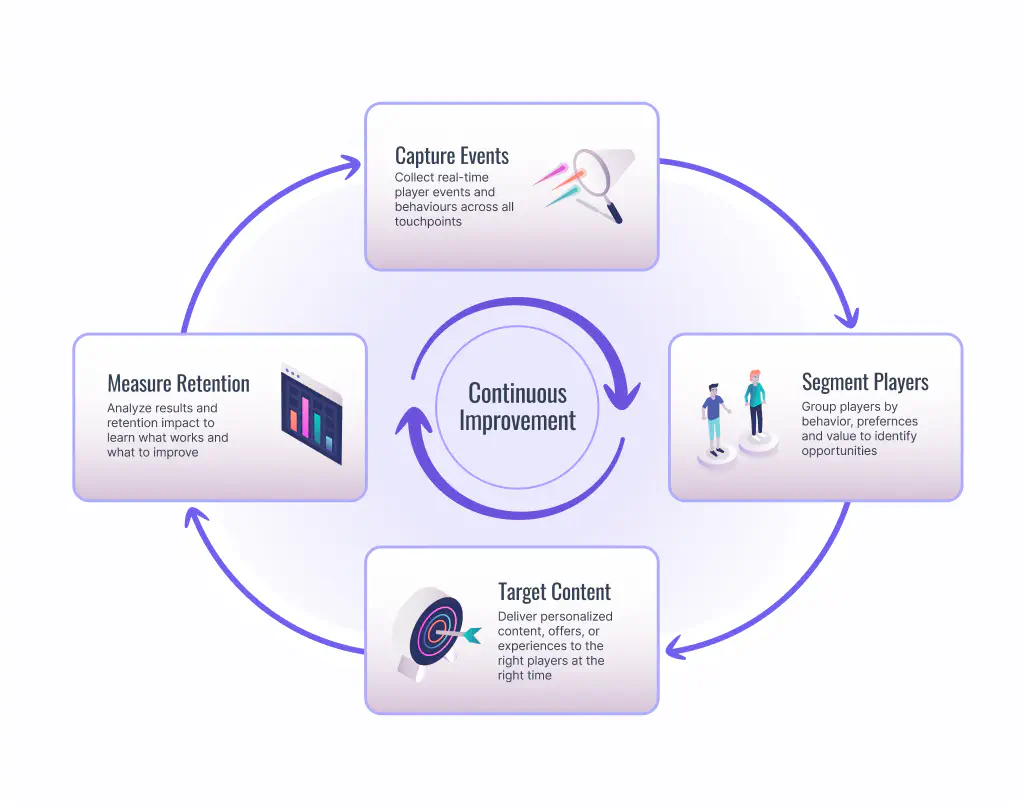
The engagement loop: capture, segment, act, measure
Every retention win runs through the same four steps. You capture what players do, sort them into segments, act on those segments, then measure whether the change stuck. Break the loop at any step and retention leaks. Here is how the four steps map to our stack.
| Loop step | What it does | In our stack |
|---|---|---|
| Capture | Logs every player event: sessions, purchases, progression, and drop-off | Satori event pipelines and taxonomy |
| Segment | Sorts players into audiences that refresh on their own | Satori audiences and segmentation |
| Act | Ships live events, offers, rewards, and experiments to each group | Satori live events with Hiro economy and rewards |
| Measure | Reads D1, D7, and D30 retention, plus funnels and custom metrics | Satori analytics and funnels |
Retention features: give players a reason to come back
This is Hiro’s job. Hiro is our game development kit. It drops meta-game systems into Unity, Unreal, and Godot games. Those systems are the hooks that pull players back: economy and currencies, energy systems, and rewards. Progression, achievements, and event leaderboards round it out. You configure them with JSON config instead of coding each one from scratch.
Invincibles Studio shows the pattern. The maker of the Soccer Manager series, with over 75 million downloads, started on open-source Nakama. It scaled up with paid Hiro to control the cost of the live-game layer.
Nakama alone can still carry retention hooks when the social and competitive layer is the pull. Small Impact Games built the looter shooter Marauders on Nakama with a small team and no dedicated backend engineer. Player crews run on Nakama Groups. Leaderboards track progression and add a competitive pull that keeps players in the fight. The game holds more than 15,000 concurrent players. It manages over 330,000 accounts and 25 million storage objects.
Analytics: know what is happening before you react
Satori ships the analytics that tell you where retention is leaking. You get graphs for D1, D7, and D30 retention out of the box. Funnels, custom metrics, and alerts sit right beside them. You spot the level where players quit, or the day the curve drops, without wiring up a separate tool.
Here is the part managed platforms cannot match. Nakama is open source, so your player data stays yours. Satori streams raw events straight to your own warehouse in real time. Think BigQuery, Redshift, and S3. You run your own analysis on your own terms. No black box. No lock-in.
Studios ship real games on this. Remedy Entertainment runs FBC: Firebreak, a three-player co-op shooter, on Nakama.
Content tooling: act while the player is still around
Analytics without action is just a nicer report. Satori is where you close the loop. You run recurring live events, battle passes, and offers on a schedule. Push notifications ride the same cadence. You target a segment, or drill down to a single player, and hand out exclusive rewards. Feature flags and A/B experiments let you test a change on a slice of players before you roll it wide.
Well Played Games runs that loop on Clans of London. The studio uses Satori for audience segmentation, live events, and feature flags, so offers and Chronicles land differently for new players, returners, and spenders. Capture, segment, act, measure, then run it again.
How to increase player engagement
You increase player engagement by acting on player data, not just collecting it. Capture what players do, sort them into segments, and ship content that responds to their behavior. Reporting on its own will not move retention. Acting on it will.
A few moves earn their keep. Run live events on a regular cadence so there is always a reason to log back in. Personalize offers and rewards by segment instead of blasting the same thing at everyone. Test changes with experiments before you roll them wide. Then watch D1, D7, and D30 retention to see what actually stuck. Our analytics dashboards show those retention numbers out of the box.
This is the loop Satori and Hiro were built to run. Hiro hands players the reasons to return. Satori tells you whether it worked, and who to reach next.
Own your data, and run it managed
No single setup fits every studio. Self-hosting Nakama means you run the infrastructure. You provision servers, patch them, and pay for the compute behind them. In return, you own the whole stack and every byte of player data.
If you would rather not run it, Heroic Cloud hosts the same stack for you. It holds SOC 2 Type II certification, audited by an independent firm. You keep the open core and the data ownership, and we carry the operations. Control and managed ops are not opposites here.
If retention is the goal and you would rather not run a black box between you and your players, an open core with LiveOps on top is the safer long-term bet.
About Heroic Labs
Heroic Labs makes Nakama, the open-source backend at the core of the stack, plus Satori for LiveOps and Hiro for meta-game systems. Named customers in this guide include Well Played Games on Satori, Remedy Entertainment on Nakama (and the wider stack), Invincibles Studio on Nakama and Hiro, and Small Impact Games on Nakama. Our managed infrastructure, Heroic Cloud, holds SOC 2 Type II certification, audited by an independent firm.
FAQ
What is a player engagement platform?
What is the difference between Hiro and Satori?
How do you increase player engagement?
What is a player segmentation tool?
Built for live games
See how Heroic Labs helps studios run LiveOps that move retention and revenue.
Walk through Satori: retention and RoAS analytics, audiences, A/B tests, and live events in one LiveOps workflow. Book a demo to see it in action.
- SOC 2 Type II certified
- Audiences, A/B tests & live events in one platform
- Supporting $5B+ in games revenue
