
What Is Meta Game Design? A Practical Guide to Retention, Loops, and Economy

The systems wrapped around your core gameplay decide whether a player comes back on day 7, day 30, and the day after that.
Most of the players you paid to acquire are gone inside a month. Commercially marketed games average 3 to 6 percent day 30 retention, per AppAgent’s 2026 benchmarks. Meta game design is what stands between launch day and that number. This guide walks through the meta game features, the retention loops, and the player progression systems that shape the curve. It also covers the rules for designing a game economy that holds up, so a live game economy doesn’t collapse under its own generosity.
What is meta game design?
Meta game design is the practice of building the systems that sit around your core gameplay and give players a reason to come back tomorrow. It covers progression, the virtual economy, and reward structures. Energy limits, achievements, and guilds live in that same layer.
Your core loop is the match, the level, or the run. It’s the thing players do with their thumbs. The metagame is everything that happens between those moments. It’s the currency they banked, the skill tree branch they opened, and the guild event that resets on Monday. Studios lose players when the core loop is fun and the meta layer is thin. Nobody uninstalls because the puzzle mechanic broke. They uninstall because nothing was waiting for them.
Why does the metagame decide retention?
The metagame decides retention because failures cluster at the intervals the meta layer controls. AppAgent reads a weak day 1 as an onboarding problem, a drop at day 7 as a habit problem, and a weak day 30 as a depth and live ops problem. Creative budget aimed at the last two won’t move them.
| Retention interval | Likely cause | First metric to check |
|---|---|---|
| Day 1 | Onboarding or expectation mismatch | Tutorial completion and first-session drop-off |
| Day 7 | Daily habit never formed | Return rate and session frequency |
| Day 30 | Thin progression, economy, or live ops | Progression depth reached and payer retention |
The benchmarks are unforgiving. AppAgent’s 2026 working ranges for commercially marketed titles put average day 7 retention at 10 to 15 percent and average day 30 at 3 to 6 percent. Good tier at day 30 is 8 to 10 percent. Top tier is 12 percent and up. Their read on a marketed game below 3 percent at day 30 is blunt. That’s rarely a creative or targeting problem. It points at product, progression, or live ops.
Genre changes the target. AppAgent’s first rule is to benchmark against your own genre, platform, and channel, not a pooled global average. A hypercasual game and a strategy game run on different business models, so a healthy strategy number can look broken next to a hypercasual one.
The market has moved the same way. Sensor Tower’s State of Mobile 2026 reports gaming in-app purchase revenue approaching $82 billion in 2025, up 1.3 percent year over year. Total IAP across apps and games reached $167 billion, up 10.6 percent, so games took a shrinking slice of a growing pot. Time spent rose while downloads fell. Growth now comes from expanding lifetime value inside the base you already have. That’s metagame work.
What are the core meta game features?
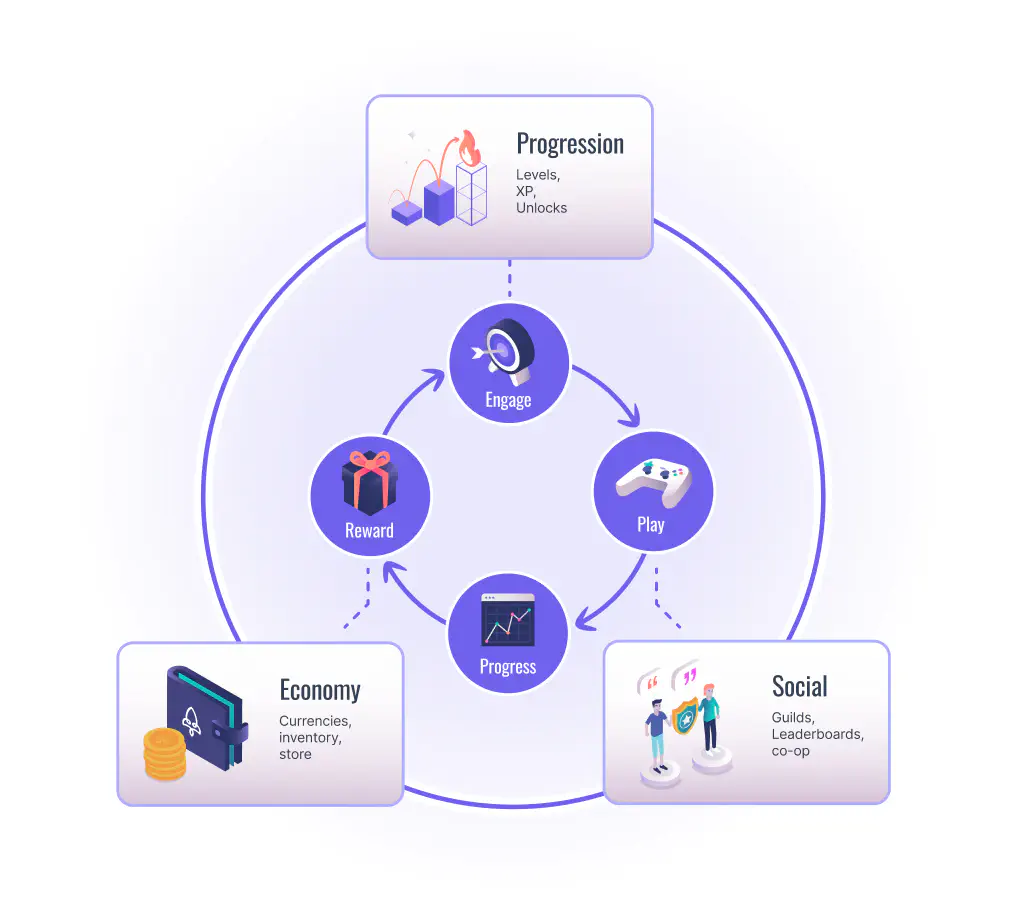
Meta game features are the standardized systems most live games ship. Currencies, progression, and rewards form the core. Energy limits, stores, and guild structures follow close behind. Almost every studio builds the same list, and almost every studio builds it twice.
Here’s the working set:
- Virtual wallet. One or more currencies, granted and spent through the game economy, with balances tracked per player.
- Inventory. Gameplay items that stack, get consumed, and get awarded.
- Progression. A dependency tree rather than a flat list. Advancement gates behind preconditions you combine: all of them, any of them, or exactly one of them. A node can require a finished achievement, a minimum stat, or a currency balance. Progressions can unlock other progressions, which is how deep player progression systems get built without a flat unlock list.
- Energy. A limiter on how often a player can act. Refills arrive through time, an ad watch, or a donation from another player.
- Rewards. Guaranteed drops, weighted random loot tables, and time-limited modifiers that change what a grant pays out.
- Store and bundles. Soft currency and hard currency purchases with server-side receipt validation.
- Social systems. Teams and guilds, plus donations that reward both sides.
How do retention loops actually work?
A retention loop is a repeatable cycle of play, reward, and spend that resolves on a predictable clock. Players learn the clock. Design four of them, and each one has a different job on a different cadence.
- Session loop. Runs inside a single sitting: play, earn, spend, play again. It has to close cleanly in a few minutes. Example: a match run that pays coins you spend on a booster before the next run.
- Daily loop. Where energy and lives earn their keep. A limited resource recovers on a timer, so players feel the day as a budget instead of an endless session. Faster refill means more plays today; a slower refill stretches the same tank across the evening. Example: a lives system that hands back one life every ten minutes.
- Weekly loop. Runs on event leaderboards and guild activity. It gives lapsed players a reason to return on a known day. Example: a guild war that resets every Sunday.
- Seasonal loop. Resets progress and reopens the chase. A longer cadence clears old unlocks and starts a new ladder, so returning players have something new to climb without waiting on a client patch. Example: a new season of levels that unlocks when the old one closes.
The failure mode is uniformity. Four loops that pay out the same reward on the same cadence read as one loop with extra steps.
How do you approach game economy design that holds up?
Game economy design comes down to sources and sinks. Every currency needs a way in and a way out, and the ratio between them is the whole balance problem. A live game economy with generous sources and weak sinks inflates until rewards stop meaning anything.
Split your currencies first. Soft currency is earned through play and should have deep sinks. Hard currency is bought with real money and needs tighter faucets. Our economy system handles both. New accounts can start with a configured set of currencies and items, and currency transactions run atomically underneath.
Three rules hold up under scale.
- Grant on the server, always. An economy the client can write to is an economy someone else controls. Server authority is not optional on the meta layer.
- Validate every purchase. Server-side receipt validation against the App Store and Google Play belongs in your backend, next to the grant it authorizes.
- Verify ad rewards server-side. Our rewarded video integration covers ironSource and AppLovin MAX. The network calls your Nakama server directly when a player finishes an ad. The signature gets checked, then the reward gets granted.
Watch payer retention as its own series. AppAgent puts whales at roughly 1 to 2 percent of the player base while they drive 50 to 70 percent of total revenue. A blended day 30 curve can look healthy while the players funding the game quietly leave.
Meta game design checklist
Run any live game or prototype against this list before you call the metagame done:
- A core loop that resolves in a few minutes and clearly feeds a metagame layer built on top of it
- Progression that gates advancement behind meaningful preconditions, not a flat unlock list
- At least two retention loops on different cadences, each with its own reward and reset logic
- Every currency backed by a source and a sink you can point to on a diagram
- All grants, purchases, and ad rewards validated on the server, never trusted from the client
- A way to retune energy timers, drop rates, and loop cadence without shipping a client patch
Common metagame design mistakes
These show up again and again in postmortems:
- Shipping one loop cadence dressed up as four, so daily, weekly, and seasonal systems all pay out the same reward
- Letting the client write to wallet or inventory balances directly instead of granting on the server
- Skipping server-side receipt validation on IAP or rewarded ads
- Building progression as a flat unlock list instead of a dependency graph, so every new system needs bespoke code
- Reading a blended day 30 curve as healthy while payer retention quietly falls
- Locking economy tuning behind an app-store release cycle instead of a remote config path
Where do Hiro, Nakama, and Satori fit?
We build the metagame layer as a toolkit, not a service you rent. Hiro is a client-server library built on Nakama, driven by JSON config, so a designer can retune an energy curve or a loot table without an engineer rewriting server code. There’s a C# package for Unity, a C++ plugin for Unreal, and more, plus a server package that loads into your backend.
It runs on Nakama, our open-source backend under the whole stack. That matters for ownership. We’ve developed Nakama since 2015 across more than 100 releases. It’s cleared performance tests up to 2 million CCU and serves over 1 trillion requests a month. Over 1 million developers build on it. You can self-host Nakama or run it on Heroic Cloud, and move between the two. Your player accounts and your economy tables stay yours either way. No black box in the middle of your live game economy.
Scaling and hosting is where larger studios, publishers, and enterprise teams feel the operational load. Heroic Cloud is the managed path there, running dedicated Nakama clusters as a production enterprise game backend. It expands capacity within seconds without downtime and offers multi-region deployment on GCP or AWS. A private cloud option is there when you need it.
Satori is the LiveOps half, a standalone product that pairs with Nakama. A personalizer connects the two, so every Hiro system becomes remotely configurable through the Satori console. Satori checks for flag overrides on the current player and merges them into Hiro’s static config before it returns. An economy tuning change becomes a real experiment with audiences and variants rather than a guess shipped to everyone. No extra client code.
Invincibles Studio took that path. The team behind the Soccer Manager series, with over 75 million downloads and 1 million active players, started on our open-source Nakama and scaled up with Hiro. Their Technical Director, Nathan Broadbent, pointed to the flexible business model as the deciding factor. They could start small and expand as the project matured. Hiro systems already live in their titles include Inventory, Economy, and Progression, with more on the way.
Should you build your metagame or buy it?
Build it yourself when the meta layer is the game. If your progression model is the thing players talk about, own that code. Buy a toolkit when the systems are standard. Currencies, inventory, and stores are the same months of work at every studio. Reward engines only add to it.
A production economy needs currencies, an inventory service, and a store with receipt validation. It also needs a reward engine that survives a bad actor with a packet editor. That’s months of engineering before a single player sees a coin. Our position is that the standardized parts should be a library you configure, with the code underneath open source, so speed never costs you control.
| Factor | Build it yourself | Buy a toolkit |
|---|---|---|
| Time to ship | Months before the first coin | Weeks to configure standard systems, then extend what is unique |
| Who runs the servers | Your team handles scaling, uptime, and security | Self-host, or run the same stack on Heroic Cloud |
| How far you can change it | Full control, and you maintain all of it | Tune common systems with config; write open code for the rest |
| Lock-in | None, but you pay for that in engineering time | Low: your data and open-source backend stay yours |
The core loop earns the first session. The metagame earns the next month. It lives or dies on progression, economy, and the loops that tie them together. See how our Hiro toolkit ships those systems on open-source Nakama.
FAQ
What is a metagame in games?
What is the difference between the core loop and the meta loop?
Do metagame systems need a game backend?
How do you measure whether your metagame is working?
How long does it take to build metagame features from scratch?
Enterprise metagame systems
See how studios ship economy, progression, and social systems without rebuilding them.
Walk through Hiro on Nakama: rewards, inventories, currencies, and event systems your team can configure and ship faster. Book a demo to see it in action.
- SOC 2 Type II certified
- Production-ready economy & progression modules
- Supporting $5B+ in games revenue
