
How to Reduce Game Churn Rate With LiveOps and Player Segmentation


Churn is a measurement problem before it’s a retention problem. Here’s how to find where players leave, then win them back with targeted events and experiments.
You paid to acquire the player. They installed, opened the game once, and never came back. That is churn, and it is the most expensive leak in a live game. To reduce game churn rate, you first have to see it, because churn is simply the share of players who don’t return after a given day. The numbers are sobering. Even strong titles lose most of the players they paid to acquire within the first month, and the drop starts as early as day one. Small shifts in churn compound hard across a big cohort, so a few points either way is real money.
Full disclosure before we go further. We build Satori, so we have a stake in this. The churn benchmarks here come from third-party sources, each linked on the claim it supports, and the method works on any competent stack.
What causes game churn?
Game churn happens when players stop finding a reason to come back, and the reason shifts depending on when they leave. A weak day-one number usually points to onboarding, or a gap between what the ad promised and what the game delivered. A drop by day seven is a habit problem, where the core loop stopped pulling players back. A slide by day 30 is a depth and game LiveOps problem, where there was nothing new to reach for. AppAgent’s mobile game retention benchmarks map those same three intervals to onboarding, habit, and depth. The lever has to match the interval. That is why the first move is diagnosis, and why a blanket “boost retention” push tends to burn a quarter.
| Interval | Likely Cause | First Metric to Check |
|---|---|---|
| Day 1 | Onboarding friction or a gap between the ad and the game | Tutorial completion and day-one retention |
| Day 7 | Habit problem, the core loop stopped pulling players back | Day-seven retention and session frequency |
| Day 30 | Depth and game LiveOps gap, nothing new to reach for | Day-30 retention and live event or content engagement |
Blended dashboards hide all of this. Look at a single average and it reports that retention is fine, even as a specific cohort collapses underneath it. Mixing day one with day 30, or paid with organic, buries the signal you need. Break the number down by cohort and by day, and the leak shows itself. Healthy organic retention next to weak paid retention points at acquisition quality. Weak retention across every cohort points at the product. Those are different problems with different fixes, and you can’t read them off a single headline figure.
How do I reduce game churn?
You reduce game churn rate by running a tight, repeatable loop: measure where players drop off, segment the ones slipping away, then prove the fix with an experiment. Lowering game churn is not a single trick. It is that loop, run again and again on your own data. Satori, our LiveOps and player engagement platform, was built to run it end to end.
- Measure where players drop off.
- Segment the players who are slipping away.
- Target them with a live event.
- Prove the change with an experiment.
- Promote the winners or kill what didn’t work.
Measure the drop-offs first
You can’t fix a leak you can’t see. Funnel analysis mirrors the sequence of actions a new player is meant to take, and shows exactly where they fall out. That might be a tutorial step, a paywall, or a difficulty spike. Retention graphs and cohort views then tell you whether last week’s change actually held. Our Satori analytics ship with built-in metrics like retention, session depth, and ARPDAU from day one, so your team reads behavior instead of building a data pipeline first. Begin with the drop-off that costs you the most players, not the one that is easiest to reach.
Segment the players who are slipping
Once you can see the leak, split your players so you act on the right ones. This is where a player segmentation tool earns its keep, and player segmentation liveops is what turns a static player list into groups that stay current as behavior changes. In our Satori you build audiences from filter expressions that match your own gameplay, and each audience refreshes continuously as players cross in or out of its definition. Segment by level reached, by days since last session, or by spend. Define inclusion and exclusion lists to override membership by hand, and pull in segments from your own systems when you already have them. A player who stalled at level 12 and a spender who hasn’t opened the app in a week need different treatment. Now you can address each on its own terms.
Target the right players with live events
A segment does nothing until you act on it. Live events let you run scheduled changes against specific audiences and measure reactivation as it happens. Bring stalled players back with a limited-time reward tuned to the wall they hit. Give lapsing spenders a concrete reason to open the app this weekend. Feature flags for games and remote config for games push those changes without shipping a new client build, and let you roll one back the moment the data turns against it. You get to meet the player who is about to leave with something aimed at that exact player.
Prove the change with an experiment
Never assume a change worked. Run it as an experiment. Our Satori experimentation engine applies a variant to an audience, holds a control group back, and shows whether the change lifted game player retention or quietly hurt it. Promote the winners to permanent feature flags. Kill the ones that did nothing. Audiences plus experiments turns “we think this helps” into a measured lift you can defend in a review. That combination sits at the core of how we run retention work in Satori.
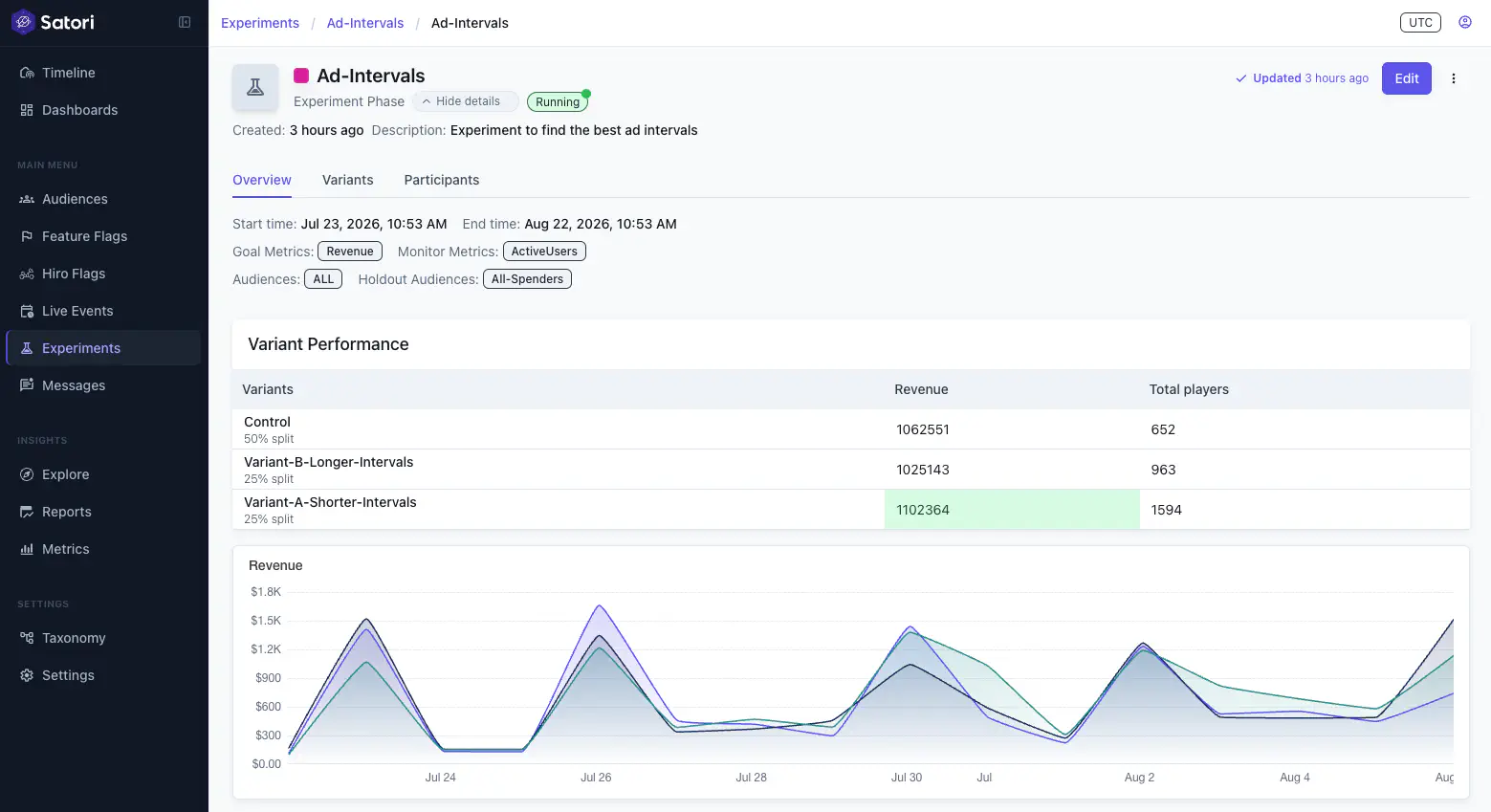
A worked pass through the loop: say you want the ad cadence that earns the most without burning the base. Put every player in the experiment audience, hold spenders out so a revenue-sensitive group doesn’t skew the read, and ship two variants against a control: shorter ad intervals and longer ones. Make Revenue the goal metric and watch Active Users beside it so a revenue win that hollows the session base still shows up. In the Ad-Intervals run below, the shorter-interval variant leads on Revenue. If that lead holds past your significance bar, promote it to a permanent feature flag. If Revenue rises while Active Users fall, or the lift never clears the bar, kill the variant and try a different lever.
How do I improve player retention?
Improving player retention is the same work as lowering churn, read from the other side of the number. As Tenjin’s retention glossary puts it, if day-seven retention is 20 percent, then day-seven churn is 80 percent. The two always add up. Healthy mobile benchmarks land around 25 to 40 percent on day one, near 20 percent by day seven, and 5 to 10 percent by day 30, though your genre sets the real target. Business of Apps reports similar game numbers. Day-one retention sits near 35.7 percent on iOS and 27.5 percent on Android, then drops to 5 percent and 2.6 percent by day 30. You move those numbers by fixing the specific interval that leaks, then holding the gain with the loop above.
Two things keep that loop durable over a game’s life. The first is owning your data. Player behavior is your most valuable asset, and renting access to it, or handing it to a black box you can’t inspect, is a risk you don’t need to take. Our Satori keeps your data under your own governance and exports raw events to your data warehouse when you want them elsewhere. Larger studios and publishers can run the same loop without giving up that ownership. Heroic Cloud hosts Nakama and Satori as a managed stack with production ops, multi-region deployment, and SOC 2 compliance, so scale doesn’t force a rebuild. The second is that the stack holds when the game gets big. FBC: Firebreak, Remedy’s three-player co-op shooter, runs its matchmaking on our Nakama and its LiveOps on our Satori. The loop that trims churn on a small title is the same loop that carries a launch spike.
One honest caveat. This loop is not a quick fix. It asks for real instrumentation, clear audience definitions, and the patience to run experiments to significance. It will not rescue a game whose core loop players do not enjoy. What it does is find the specific leak and prove the fix, so your effort lands where it moves the number.
Churn is not a mystery. It is a set of drop-off points you can measure, a set of players you can segment, and a set of changes you can test and then keep or throw away. Read the leak, act on the right audience, and prove the fix before you call it a win. That is how game player retention actually moves, and it is the workflow our player engagement platform was built to run, on infrastructure and data that stay yours. Plenty of studios already run it on our stack.
FAQ
What is a good churn rate for a mobile game?
What is player segmentation in a game?
How do live events reduce churn?
Can A/B experiments actually improve retention?
Built for live games
See how Heroic Labs helps studios run LiveOps that move retention and revenue.
Walk through Satori: retention and RoAS analytics, audiences, A/B tests, and live events in one LiveOps workflow. Book a demo to see it in action.
- SOC 2 Type II certified
- Audiences, A/B tests & live events in one platform
- Supporting $5B+ in games revenue
