
How to Make an Online Multiplayer Game: Architecture, Tools, and Backend


The architecture calls that decide whether your first multiplayer game ships or gets rebuilt under load.
Search how to make an online multiplayer game and you’ll get socket code. Reams of it. Almost none of it tells you the part that actually decides whether your game survives contact with real players. That part is the architecture underneath, and it’s a set of choices you make before you write a single line of netcode.
This guide walks those choices in the order they matter. We’ll cover how to build a multiplayer game from scratch, starting at the architecture level. Then the online game backend that carries it, and the road from a prototype on your laptop to production. The same calls apply whether you’re shipping on mobile, PC, or console. Most of online multiplayer game development really is just making them well, early. Get them right and the backend grows with your player count. Get them wrong and you’ll be rebuilding under load, with users watching. We build our Nakama out in the open, so most of what follows is us showing our work.
Step 1: Choose your network model (client-server or peer-to-peer)
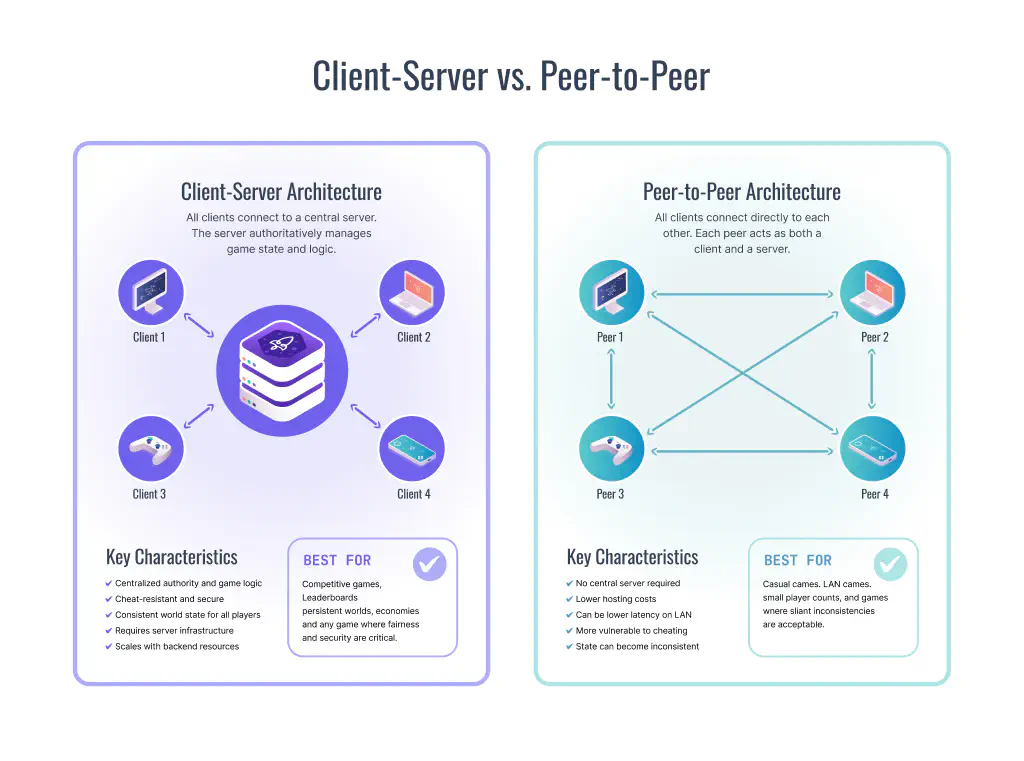
Almost every online multiplayer game runs on client-server. One machine holds the authoritative copy of the game, and every player connects to it. That is online multiplayer game architecture in a single sentence, and everything else in this guide hangs off it.
The Valve Developer Community puts it plainly. The server is authoritative about world simulation, game rules, and player input, and clients only ever talk to the server, never to each other. Peer-to-peer drops that central server and wires players together directly. For a small group of people who trust each other, it can be cheaper to host. It also hands every peer a copy of your game state and no real answer for the moment a host disappears mid-match. Anyone can read or fake what they can see. Hosts vanish and take the match with them. Those problems stay hidden right up until your game gets popular or competitive, which is exactly when you can’t afford them.
Settle this one first. A single server gives you one place to keep state, run anti-cheat, and change the rules without shipping a client patch to every player. P2P gives you none of that. Our architecture overview for Nakama shows one way the pieces line up once you’ve made the call.
Step 2: Put the server in charge (authoritative or relayed)
An authoritative game server owns the match. Clients send their inputs up, the server runs the simulation, and it sends back a result nobody on the client side can forge.
Gabriel Gambetta describes clients in this model as privileged spectators, and points out that it shuts down most cheating on its own. You won’t always want that much control. A fast co-op game among trusted players can run relayed, where the server just passes messages between clients and stays out of the simulation. Nakama does both. Run the game loop on the server for authoritative multiplayer with a custom tick rate from 1 to 60 Hz. Or keep the server out of it with client-relayed matches, the better pick when clients are trusted and latency matters more than control. One gives you anti-cheat and a single source of truth. The other trades that away for raw speed.
There is a catch with authoritative servers, and it’s why people reach for relayed too early. Every input takes a round trip, so a naive build feels sluggish. Client-side prediction is the fix. The client shows your action immediately, then quietly corrects itself when the server’s real answer lands. Gambetta’s series walks through this, along with entity interpolation for smoothing out how other players move. Layer prediction on top of an authoritative server and it feels responsive without you giving up a thing.
Step 3: Separate realtime traffic from everything else
Not all of your traffic is urgent. Realtime multiplayer needs a live connection held open for the whole session. Logging in, loading a profile, reading an inventory, none of that does.
A socket is what keeps that live channel open, so the server can push you an update the instant something changes instead of waiting for you to ask. The MDN Web Docs reference on WebSockets covers the mechanics well. A WebSocket runs two ways at once over one connection. Client and server both send the moment they have something to send. No polling on a timer, no lag baked into every update. Turn-based moves and social features don’t need any of that machinery.
Nakama splits along the same line. The socket interface runs on WebSockets and rUDP for the realtime stuff, chat and live multiplayer. The request interface runs on gRPC and HTTP for account management. You decide feature by feature which side something belongs on. A matchmaking lobby is realtime and lives on the socket. Reading a leaderboard isn’t, and doesn’t. Get that division right and you end up with a server that stays cheap and a game that stays responsive.
Step 4: Handle matchmaking and the social layer
Matchmaking sorts players into matches by skill, region, or whatever rule you decide. The social layer, friends and chat and groups, is the part that makes them come back tomorrow. Neither is a gameplay problem, and both sit underneath the game rather than inside it.
At minimum, matchmaking needs presence (who’s online and available right now), a way to form a party or lobby, and queue criteria to pair players by. The social layer needs somewhere to store friend relationships, group membership, and chat history that survives between sessions. Both need to know who a player is before they can do any of that, so identity and authentication belong to this layer too.
None of that is specific to your game. Every team building online games ends up solving the same presence, queueing, and identity problems, whether the game is a shooter or a puzzle title. That’s the case for integrating a backend that already has this layer solved rather than building it: the work is real, it’s identical across most games, and it competes for engineering time against the parts of your game that are actually different. Build it yourself only when matchmaking or social features are the differentiator, say a novel skill-rating algorithm, rather than table stakes you’d otherwise buy off the shelf.
Step 5: Choose your backend (build it or run ours)
Your multiplayer game backend has one job description: own your data, scale with your players, and let you change server logic when you need to. You can build something that does that, or run something open source that already does.
Build it from scratch and you’re writing authentication, matchmaking, and storage yourself, then keeping a realtime layer alive while traffic climbs. Reach for a fully managed black box instead and you move fast, but you’re renting the infrastructure and handing your data to someone else. We built Nakama as the third option. It’s open source under Apache 2.0, so the stack is yours and you run it wherever you like. Write your game logic in Go, TypeScript, or Lua. Query the database directly. No black-box restrictions. Extend the server with your own RPCs, and with before and after hooks that run on any request. That’s how your rules, your validation, and your economy end up on a server you control, instead of inside a client someone can crack open.
This is where the matchmaking and social layer from Step 4 actually lands. Nakama ships matchmaking that pairs on required, desired, and optional characteristics, with free-text search on top. Friends, groups, and chat come built in. Leaderboards, tournaments, and parties sit on the same server, so the competitive loop is there without extra vendors. Authentication runs through social logins, device IDs, or a custom flow you write yourself, and the storage engine gives you collections plus direct SQL access to the game database. Player data lives in your database, in a shape you chose, not locked behind somebody’s API. Notifications and in-app messages ship with it. That’s the whole account and social stack coming from one server instead of five. Wire all of it yourself and you’ll burn months on plumbing before the game is any fun. Or don’t, and spend those months on the game.
Nakama is a single stateful server, so you’re not gluing a queue to a cache to a stack of microservices just to get realtime working. One backend handles realtime multiplayer, social systems, and the competitive layer. When a single node stops being enough, Nakama Enterprise spreads the load across a cluster and keeps running if one of them drops. That’s the scalable realtime multiplayer backend for online games we set out to build in the first place.
Step 6: Deploy locally, then scale to production
Start on your own machine. Nakama comes up in a few minutes with Docker and a Postgres-compatible database like CockroachDB, which is enough to prototype the whole thing locally. When you outgrow one node, Nakama Enterprise coordinates a cluster over a gossip protocol and takes the single point of failure off the table. From there you can deploy it to any cloud provider yourself, or hand the operations to our Heroic Cloud and stop thinking about them. Heroic Cloud is the managed path for larger studios, publishers, and enterprise teams. They get production ops, multi-region deployment, and SOC 2 compliance without rewriting their stack.
Heroic Cloud runs production Nakama clusters with managed scaling and zero-downtime deploys. It sits on Google Cloud and AWS across regions, ships observability out of the box, and holds SOC 2 Type II. Scaling out takes you from a handful of servers to dozens inside a few minutes. This isn’t theoretical, either. More than 1 million developers build on Nakama today. It’s been tested to 2 million concurrent users, and it serves over a trillion requests a month across live games. Your data stays yours the whole way, stored apart from every other user on the platform. Self-hosted or managed, you keep the backend and you keep the data. That was always the point.
Common mistakes when building an online multiplayer game
Most of the rebuilds that follow a rough launch trace back to one of these:
- Picking peer-to-peer for a competitive or shared-economy game. Cheating and host dropouts stop being theoretical the moment the game matters to anyone.
- Letting clients own shared state. Validating on the client instead of the server hands your trust boundary to a device you don’t control.
- Putting non-urgent traffic on the realtime socket. Pushing login, inventory, or profile reads through the same channel as live match state wastes connections and adds latency where it doesn’t matter.
- Rebuilding authentication, matchmaking, and storage from zero. These are solved problems. Teams that write them from scratch spend months on plumbing before the actual game exists.
- Skipping client-side prediction on an authoritative server. Every input takes a round trip without it, and the game feels sluggish even though the architecture underneath is correct.
- Scaling out before the local prototype works. Chasing cluster configuration before the core loop is solid on one machine spends effort on a problem you don’t have yet.
Most of these disappear once the backend already handles the solved parts, which is the whole argument for running something like Nakama instead of writing auth and matchmaking twice.
FAQ
How do you make an online multiplayer game?
What backend do you need for an online multiplayer game?
What is online multiplayer game architecture?
Is client-server or peer-to-peer better for a multiplayer game?
Enterprise game backends
See how studios ship multiplayer at scale without rebuilding infrastructure.
Walk through Nakama and Heroic Cloud: org-level access control and managed ops without rewriting your stack. Book a demo to see it in action.
- SOC 2 Type II certified
- Proven at 2M concurrent users
- Dedicated capacity, no CCU limits
