
How to Choose a Game Backend: 5-Step Guide

A repeatable way to score any game backend before you write a line of integration code.
The wrong game backend doesn’t announce itself on day one. It shows up a few months in, when matchmaking buckles under load or a feature you assumed was standard needs a rewrite. By then you’ve shipped. Players have arrived. Switching costs are real.
Choosing a game backend is one of the few early decisions that touches every system you build after it. This guide is a framework for how to choose a game backend on evidence rather than instinct. Treat it as a game backend buyer guide you can run in an afternoon. Five checks. One scorecard. A clear read on where each kind of platform fits.
We build Nakama, so we’ll score it against the same criteria at the end. First, the criteria.
What to look for in a game backend
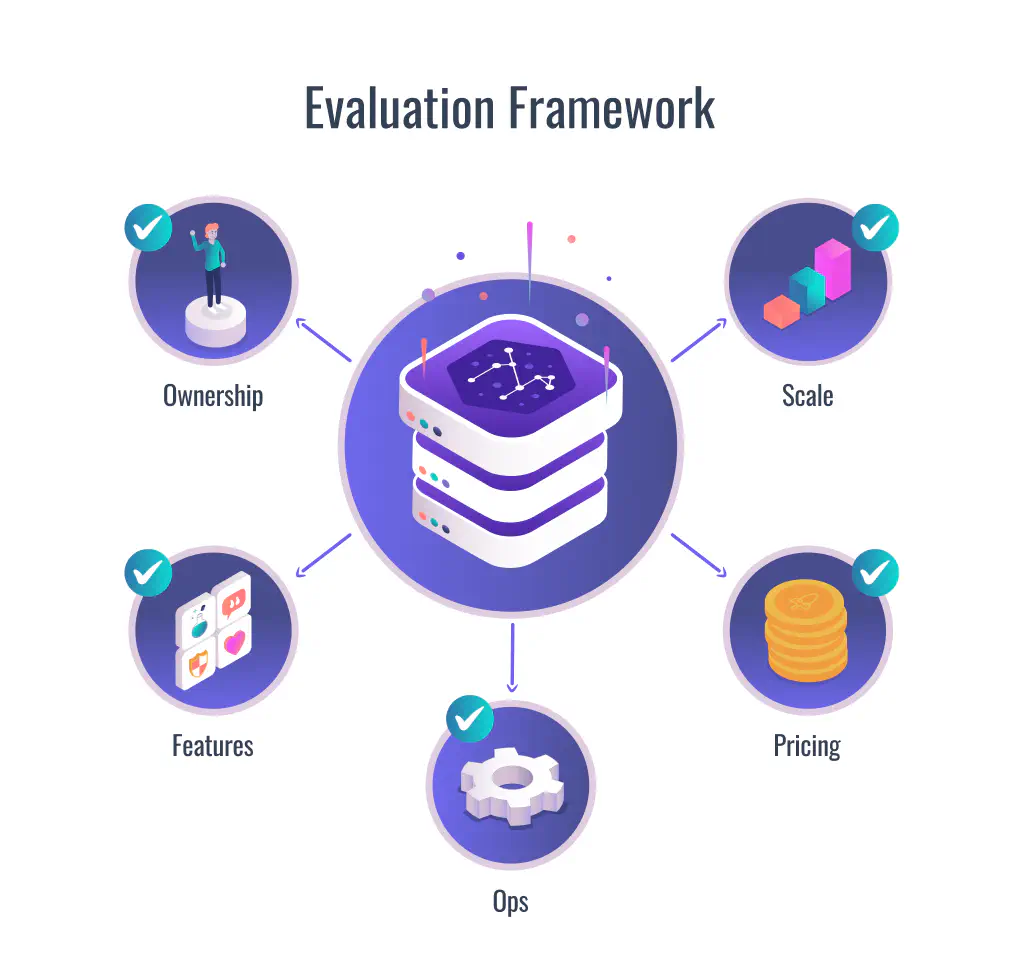
A game backend is worth choosing when it clears five criteria. It scales to your real peak. It supports the multiplayer model your genre needs. You own the code and the data. The price reflects true cost, and the client SDK fits your engine.
Selecting a backend platform gets simple once you score every option the same way. Two criteria carry most of the risk. Scale decides whether your launch survives a spike. The multiplayer model decides whether latency and cheating are yours to control or the network’s problem. The rest are real, but they rarely sink a game on their own.
How do I choose a game backend? A five-step framework
You choose a game backend by running the same five checks on every option in order, then scoring the results. Start with scale, the hardest thing to change later. Finish with engine fit, the fastest to confirm. The steps below turn a gut call into a scorecard you can defend to your team and your publisher.
1. Size the peak, not the average
Scale is the first filter because it’s the hardest to retrofit. Look at concurrent users at your expected peak, not your daily average. A soft launch that draws a few thousand players can spike well past that when a feature lands or a creator picks it up. Ask how the platform adds capacity under load, and whether that happens without downtime. Pixel Flow from Loom Games reached 10M+ players. A curve like that is a backend question long before it’s a marketing one.
2. Match the multiplayer model to your genre
Realtime support isn’t one thing. A multiplayer game backend has to answer the authoritative-versus-relayed question first, because the two solve different problems. An authoritative game server runs the match loop itself. It validates every message and broadcasts the result. That’s what you want when cheating or contested state can cost players real money. Relayed multiplayer passes messages between clients for speed. It fits fast co-op where a desync hurts less than latency. Realtime play runs over a persistent connection, usually the WebSocket protocol, so the server can push new state the moment it changes. Also check whether you can set a fixed tick rate, since update frequency should match the genre, not a vendor default.
| Model | Authority | Latency | Anti-cheat | When to use |
|---|---|---|---|---|
| Authoritative server | Server owns and validates match state | Adds a server hop per update | Strong. Server validates every input | Competitive, wagered, or contested-state games |
| Relayed (client) | Clients hold state | Lower. Messages relayed directly | Weak. Clients are trusted | Fast co-op and casual play |
An FPS looter-shooter like Marauders from Small Impact Games needs the server to own match state. A casual party game usually doesn’t.
3. Decide open source versus managed before you fall for a demo
Ownership is the criterion that quietly decides your next few years. There are three broad shapes on the market. An open-source self-host stack hands you the source and your own database, so you control the code and the data. A managed game backend as a service runs the servers for you and trades some control for less operations work. An engine-tied cloud bundles the backend with one engine, which is convenient right up until you want to move. Pick the shape, then pick the vendor.
Ownership has a legal layer too. A permissive open-source license, like Apache 2.0, means the core can’t be pulled out from under you if a vendor changes direction. That’s the line between renting your backend and owning it.
| Criterion | Self-host (open source) | Managed cloud | Hybrid |
|---|---|---|---|
| Time to ship | Longest. You run everything | Fastest. Servers are ready | Fast. Open core, managed host |
| Ops burden | High. On your team | Low. On the provider | Low to moderate |
| Customization | Full. It’s your code | Limited by the platform | Full. Same open core |
| Lock-in | None. You hold the source | Depends on portability | Low. Core stays portable |
The build vs buy game backend split isn’t actually binary. Our Nakama is open source, so you keep the source and your data. Heroic Cloud runs that same stack in production when you’d rather not run servers yourself. That’s the hybrid column, and we built it on purpose. For larger studios and publishers that need production ops, multi-region, and SOC 2 Type II compliance, Heroic Cloud is the managed path. An enterprise game backend shouldn’t mean starting over.
4. Read pricing as total cost, not sticker price
Pricing is where a cheap platform gets expensive. The sticker number is rarely the real number. Add the engineers you need to run it, the servers under load, and the cost of leaving if the fit is wrong. A free open-source core on your own hardware can beat a managed tier on paper and lose once you count the on-call rota. A game backend solution that suits a prototype rarely suits a live game at production scale. Score the total, and score it against your stage.
Run the total cost of ownership through this checklist for any platform you’re scoring:
| Cost line | What to ask |
|---|---|
| License fee | Free open-source core, or a per-tier managed price? |
| Infrastructure | Is the cloud bill yours to run, or bundled into the platform’s price? |
| Engineering time | How many hours a month to integrate, operate, and patch this platform? |
| On-call / ops | Who gets paged when the backend goes down at 2am, and what does that cost? |
| Lock-in / migration | What would moving to another platform cost you in months and dollars? |
5. Confirm engine and client fit last, since it is a fast filter
Engine fit is last only because it’s quick to confirm. List the client libraries the platform ships and check that yours is first class, not a community afterthought. If your team builds in Godot, Unity, or Unreal, look at the SDK. It should be maintained by the platform, documented, and current. This one is a yes or no. A backend that treats your engine as second class will cost you every sprint.
Game backend selection criteria: score before you commit
The game backend selection criteria map to a five-row scorecard, one row per check from the framework above. For each platform you evaluate, mark every row pass, partial, or fail using the rubric below. The highest honest score wins, and the losing rows show you the risk you take if you override it.
| Criterion | What to check | Pass | Partial | Fail |
|---|---|---|---|---|
| Scale | Peak CCU and capacity under load | Published peak or load-test numbers that clear your launch spike, with a clear scale path | Soft claims only, or capacity that covers soft launch but not a real spike | No public evidence, or scaling needs downtime / a rewrite |
| Multiplayer model | Authoritative and relayed, tick control | Both models available, and you can set tick rate to match the genre | One model only, or tick rate is fixed / undocumented | Model doesn’t fit your genre, or no realtime path |
| Ownership | Source access, own your data, license | You can read the source, keep player data, and exit without a rewrite | Data export exists, but the core stays closed or engine-tied | Black-box API only, or leaving means rebuilding the game |
| Pricing | Total cost: license, infra, ops, lock-in | You can model license + infra + ops + exit cost for your stage | Sticker price is clear; ops or lock-in cost is fuzzy | Pricing hides until sales, or exit cost isn’t knowable |
| Engine fit | First-class client SDKs | Official, maintained SDK for your engine with current docs | Community SDK or thin wrapper you have to babysit | No SDK for your engine, or abandoned client |
How our Nakama scores
| Criterion | What to check | How our Nakama answers |
|---|---|---|
| Scale | Peak CCU and capacity under load | Performance tested to 2M+ CCU. Serves over 1 trillion requests per month. |
| Multiplayer model | Authoritative and relayed, tick control | Authoritative and relayed multiplayer with a configurable 1 to 60 Hz tick rate. |
| Ownership | Source access, own your data, license | Open source under Apache 2.0. Your code, your database, your data. |
| Pricing | Free core, managed option, total cost | Free open-source core. Heroic Cloud when you want managed hosting. |
| Engine fit | First-class client SDKs | Client libraries for Godot, Unity, Unreal, and more. |
The reason our Nakama fills every row is that the stack is composable. You take the open-source core, add only the pieces you need, and host it on our managed cloud if and when you want that. Over 1 million developers, studios, and publishers build on Nakama. Small Impact Games shipped Marauders on it with no dedicated backend engineer. That’s what scoring ownership and operations burden together is meant to catch.
Choosing a game backend is a scoring problem, not a branding one. Run the five checks, fill the card, and pick the platform that clears the rows that matter to your game. When you want to see how our Nakama scores for your project, start with the open-source core and add our managed cloud when you need it.
FAQ
Do I need a game backend for a single-player game?
Is an open-source game backend production-ready?
Can I move off a managed game backend later without a rewrite?
How much does a game backend platform cost?
Enterprise game backends
See how studios ship multiplayer at scale without rebuilding infrastructure.
Walk through Nakama and Heroic Cloud: org-level access control and managed ops without rewriting your stack. Book a demo to see it in action.
- SOC 2 Type II certified
- Proven at 2M concurrent users
- Dedicated capacity, no CCU limits
