
How In-Game Currency Systems Work (and Why Live Game Economies Break)

Every coin a player earns has to come from somewhere and go somewhere. This guide explains how currencies in games actually work, why live economies drift into inflation, and how live teams catch it before players do.
What is an in-game currency system?
An in-game currency system is the part of a game economy system that defines which currencies exist, how much of each a player holds, and the rules for earning and spending them. In games, a currency is a balance in a player’s wallet that the game issues, prices against, and takes back.
Coins, gems, gold, credits, and tickets are all currencies. So are event tokens that exist for two weeks and vanish. What makes them a system rather than a counter is that every balance is tied to three things: where the currency comes from, what it can buy, and who is allowed to change it. In a live game, the answer to that last question should always be the server.
The in-game currency system sits inside the wider metagame, next to progression, inventory, and rewards. Our meta game design guide covers that layer as a whole. This guide zooms in on the currency part, because it is the part that breaks most quietly.
How do in-game currencies work?
In-game currencies work as a closed loop. The game grants currency for actions it wants to encourage, players spend it on things that move them forward, and the price of those things decides how long the loop takes. Most free-to-play games run two kinds of currency on that loop.
Earned currency (soft currency). Players get it through gameplay: finishing a level, winning a match, completing a quest, opening a daily chest. It flows in high volume and pays for routine progress like upgrades, consumables, and repairs. Its job is pacing. If it is too scarce, players stall. If it is too plentiful, nothing in the game feels earned.
Premium currency (hard currency). Players mostly get it with real money through an in-app purchase, plus small, deliberate grants from play. It buys time, convenience, cosmetics, and access to limited offers. Its job is monetization, so it needs few, tightly controlled sources and clear value. Hand out too much and you undercut your own store.
Many games add a third tier: event or seasonal currencies that only exist inside a live event or a battle pass and expire or convert when it ends. These are useful precisely because they can’t accumulate forever.
| Currency type | How players get it | What it buys | Main risk |
|---|---|---|---|
| Earned (soft) | Gameplay, quests, daily rewards, ads | Upgrades, consumables, routine progress | Inflation from too many sources |
| Premium (hard) | In-app purchase, small play grants | Time skips, cosmetics, offers, conversion to soft | Devaluing the store with free grants |
| Event / seasonal | Live event or season activity only | Event shop items, track rewards | Leftover balances that break the next event |
The soft currency vs hard currency split matters because each needs different controls. Soft currency is a pacing tool, so you tune it with sinks. Premium currency is a revenue tool, so you tune it with prices, offers, and how rarely it drops for free.
How do sources and sinks work in a game economy?
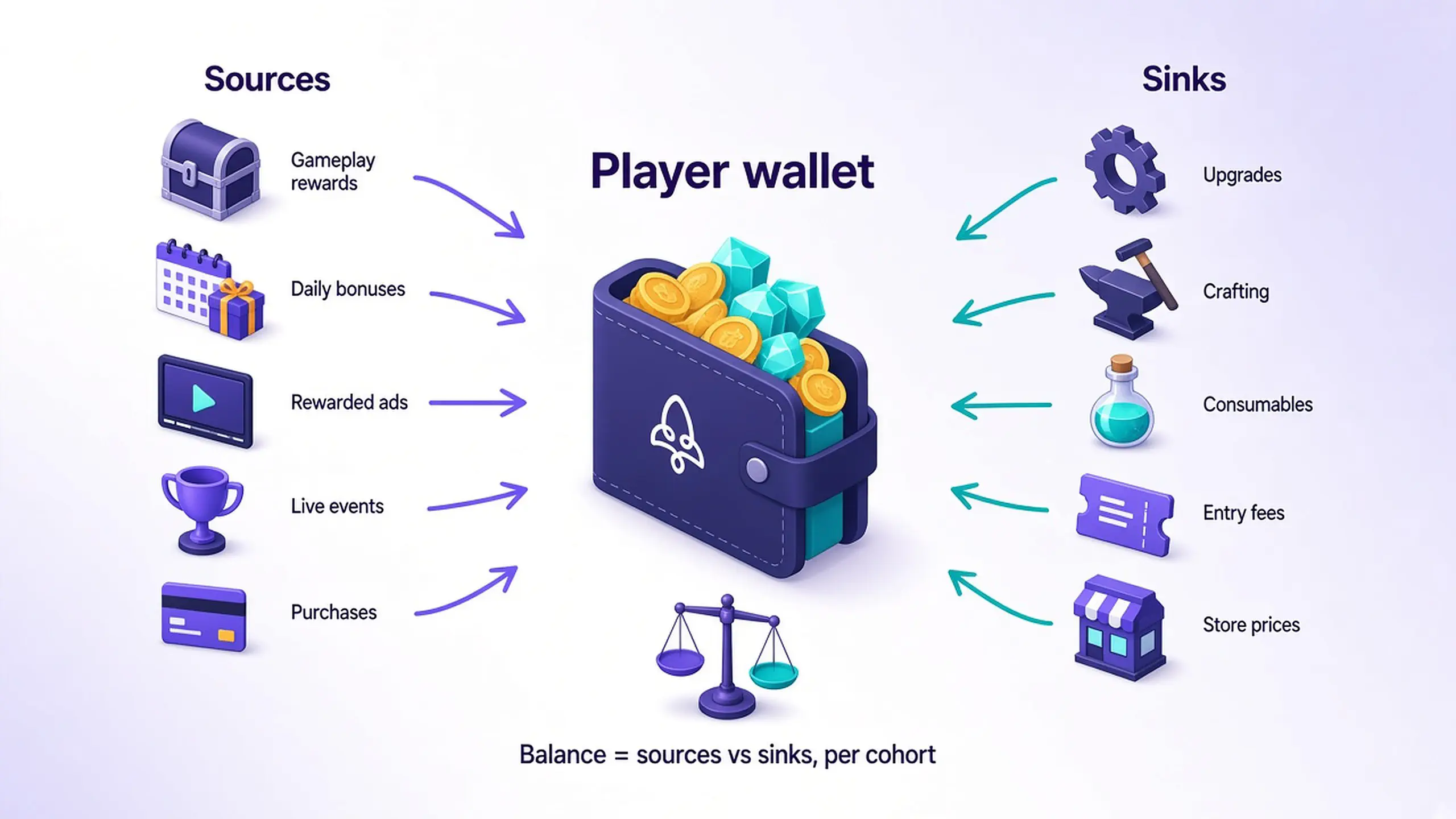
Sources and sinks are the inflows and outflows of a currency. A source (or faucet) is any place the game creates currency: level rewards, daily login bonuses, achievement payouts, rewarded ads, event prizes, store purchases. A sink is any place the game removes it: upgrade costs, crafting fees, repairs, consumables, entry fees, rerolls, and store prices.
Game economy balancing comes down to the ratio between the two. The source-to-sink ratio is the total currency granted divided by the total currency spent, per currency and per cohort, over a fixed window such as seven days. A ratio near 1 means balances are stable. A ratio above 1 means players are saving, which is expected early in progression and a warning sign for veterans.
If sources and sinks stay roughly matched for the players you care about, the currency keeps its value. If sources pull ahead, balances pile up and every price in the game gets cheaper in real terms.
Three rules keep the picture honest:
- Measure per cohort, not per server. A new player and a three-year veteran live in different economies. Averages hide the veteran sitting on ten million coins with nothing to buy.
- Count every source. Teams track the obvious payouts and forget the rest: compensation grants after an outage, gifts, mailbox rewards from an old event, rewarded video placements added late.
- Give every sink a reason. Sinks that feel like tax get avoided or resented. Good sinks buy something players want: a cosmetic, a faster path, a reroll on a bad drop, a seat in a tournament.
Some studios publish this picture. CCP releases a Monthly Economic Report for EVE Online that breaks down ISK faucets and sinks by category, one of the few public views of a live economy’s flows. Most studios keep the same dashboard internally, and the ones that don’t usually find out about inflation from their players.
Why do live game economies break?
Live game economies break because sources are easy to add and sinks are hard to add. Every live event, new feature, and apology grant puts more currency into circulation. Sinks only grow when someone designs new things worth buying, and that work lags behind.
The common failure modes:
- Inflation. Balances grow faster than prices. A rare item that once took a week of play now takes an afternoon. Rewards lose their pull, and players stop engaging with the loops meant to pay them.
- Top-heavy wealth. Long-time players hit currency caps or simply run out of sinks. They have no reason to play the earn loop, and anything priced for them is out of reach for everyone else.
- Premium leak. Too much premium currency comes from free sources. Paying players notice their purchases are worth less, and the store loses its anchor price.
- One currency doing every job. If the same coin pays for routine upgrades and premium cosmetics, you can’t tune pacing without breaking monetization.
- Exploits and duplication. A client that writes its own balance, or a reward that can be claimed twice, mints currency at a rate no sink can absorb. This is why grants have to happen on the server.
- Player-to-player markets. Trading and auction houses move value between players in ways designers don’t fully control. Blizzard closed both Diablo III auction houses in March 2014, saying they undercut the game’s core loop of earning gear by playing.
- Locked tuning. The team spots the problem, but the numbers live in the client build. The fix waits for an app store release while the economy keeps drifting.
- Untested price changes. Shipping a new price to everyone at once leaves no control group to tell you whether it worked.
Why do live game economies inflate?
Live game economies inflate because currency enters through many small, automatic faucets and leaves through a few deliberate purchases. Each new source looks harmless on its own. Together, and compounded across months of play, they outrun the sinks. Inflation rarely shows up as a crash. It shows up as engagement on earn loops slowly dropping because the rewards no longer matter.
A hypothetical example makes the math concrete. Say a veteran earns 1,000 coins a day and upgrades absorb about the same. A new 200-coin daily login bonus and a 150-coin rewarded video placement push income to 1,350 a day. That is a 1.35 source-to-sink ratio, and the veteran banks roughly 10,000 extra coins a month with nothing new to buy.
How do studios tune a live game economy?
Studios tune a live game economy by treating currency values as live configuration, not as code. Grant amounts, prices, drop weights, and event rewards should be data the server reads, so a LiveOps team can change them without a client update. That is the core of LiveOps economy design, and the reason f2p economy balancing never really ends at launch.
A sound tuning loop looks like this:
- Model before launch. Simulate game economy flows in a spreadsheet or tool: expected earnings per session, prices along the progression curve, and how long each milestone should take for a typical player.
- Grant on the server. Every source runs through the backend, which validates purchases, verifies ad callbacks, and applies balances atomically.
- Instrument every currency. Log each grant and spend as an event with its source or sink, so you can see flows per cohort.
- Change values from config. Use remote config for game economy values so prices and rewards can move the same day you spot a problem.
- Test before you roll out. Ship a change to a slice of players as an experiment, compare it to a control group, then roll out the winner. A price change is a hypothesis until you measure it.
- Watch for second-order effects. A cheaper upgrade raises engagement this week and may empty your sinks next month.
Use temporary levers for spikes instead of permanent ones. A time-limited reward multiplier (“2x coins for one hour”) or a short-lived event currency adds excitement without permanently raising the baseline.
What metrics show a game economy is healthy?
Track the economy the same way you track retention: per currency and per cohort. The useful set is small.
| Metric | What it tells you | Warning sign |
|---|---|---|
| Source-to-sink ratio | Whether currency is piling up | Ratio climbing steadily above your target |
| Median balance by cohort | Wealth for new, mid, and veteran players | Veteran balances growing with no matching spend |
| Time to milestone | How long key purchases take in practice | Milestones getting faster every update |
| Share of premium from free sources | How much free premium currency competes with the store | Free share rising after events |
| Spend rate on each sink | Which sinks players actually use | Sinks nobody touches |
| Payer conversion and retention | Whether the store still feels worth it | Payer cohort churning faster than the base |
When one of these moves, check what changed in the sources first. It is almost always a new faucet. For how economy health feeds into player loss, see how to reduce game churn rate.
Where to implement an in-game currency system
You can build the wallet, the store, and the reward engine yourself, or start from a configurable game reward system backend that already handles the hard parts. Either way, the requirements are the same: server-side grants, atomic balance changes, purchase validation, and values you can change without a release.
Hiro, our metagame toolkit built on the open-source Nakama game backend, covers that layer. Its Economy system lets you define any number of soft and hard currencies in JSON configuration, set starting balances for new players, and run currency transactions atomically on the server. The virtual store supports in-game currency costs and in-app purchases validated through the Apple App Store and Google Play. Rewarded video from ironSource and AppLovin MAX is verified server-side before the reward lands. Rewards can be guaranteed or weighted, routed to a mailbox, or scaled by temporary modifiers like “2x coins for 1 hour.”
For live tuning and experiments, Satori, our LiveOps platform for games, connects to Hiro so the Hiro economy becomes a remotely configurable feature flag. Your LiveOps team can target a discounted bundle at lapsed spenders, or run an experiment with a control and test variants on reward values, with no extra client code. TapSlots runs a server-based wallet and inventory on Hiro’s Economy features in Vegas Cherry Slots, with Satori feature flags to roll changes out.
For publishers and larger studios running several live titles, Heroic Cloud is the managed path for the same stack, with multi-region deployments, SOC 2 Type II, and economy data that stays yours. For the broader operating model, read what game LiveOps is.
FAQ
How do in-game currencies work?
What is the difference between soft currency and hard currency in games?
How do sources and sinks work in a game economy?
Why do live game economies inflate?
How do you fix inflation in a game economy?
Should currency balances be stored on the client or the server?
Can you change a game economy without a client update?
Enterprise game backends
See how studios ship multiplayer at scale without rebuilding infrastructure.
Walk through Nakama and Heroic Cloud: org-level access control and managed ops without rewriting your stack. Book a demo to see it in action.
- SOC 2 Type II certified
- Proven at 2M concurrent users
- Dedicated capacity, no CCU limits
